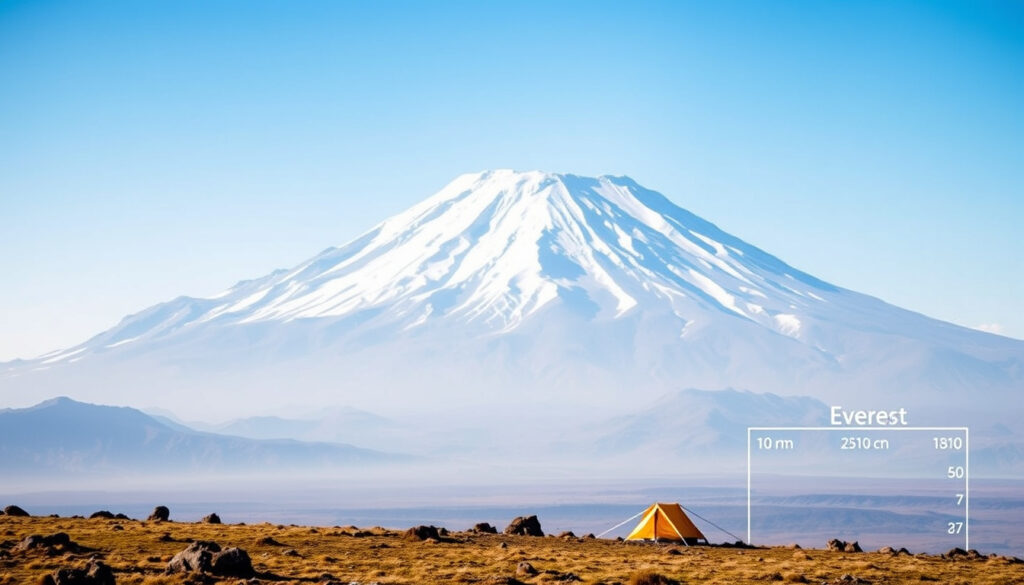
Kilimanjaro Mountain: Height, Location, Safety & Everest Compared
You’ve seen the photos of that flat-topped snow cap rising above the clouds, and you’ve probably wondered: is Kilimanjaro really a walkable peak, or is it a serious mountaineering objective? The truth is somewhere in between — and that overlap is exactly what makes Africa’s highest summit both tempting and treacherous. We’ll dig into the real numbers: its location, the altitude risks, the safety record, and how it stacks up against Everest.
Height: 5,895 m (19,341 ft) ·
Location: Tanzania, Africa ·
Type: Stratovolcano (dormant) ·
First ascent: 1889 ·
Last eruption: ~360,000 years ago ·
Annual deaths: ≈10 per year
Quick snapshot
- Located in Tanzania, Kilimanjaro National Park (National Geographic)
- Height: 5,895 m / 19,341 ft (Altezza Travel)
- Dormant stratovolcano with three cones (Wikipedia)
- Exact annual death toll not officially published (Follow Alice)
- Precise impact of climate change on snow caps debated among scientists (Follow Alice)
- Some historical eruption dates are estimated (Follow Alice)
- Climate change could eliminate glaciers by 2050 (National Geographic)
- Growing popularity drives longer itineraries for safety (National Geographic)
- New route regulations under discussion by KINAPA (National Geographic)
Six key facts, one pattern: Kilimanjaro’s physical profile is straightforward, but its real challenge lies in the air, not the rock.
| Attribute | Value |
|---|---|
| Height | 5,895 m (19,341 ft) |
| Location | Tanzania, Africa |
| Mountain Type | Stratovolcano (dormant) |
| First Ascent | 1889 by Hans Meyer and Ludwig Purtscheller |
| Last Eruption | ~360,000 years ago |
| Prominence | 5,885 m — ranked 4th worldwide |
Why is Mount Kilimanjaro so famous?
What makes Kilimanjaro unique?
- Kilimanjaro is the highest mountain in Africa
- It is the highest free-standing mountain in the world
- It has three volcanic cones: Kibo, Mawenzi, and Shira
- Its snow caps are shrinking due to climate change
How did it become a bucket-list destination?
A non-technical summit that doesn’t require ropes, ice axes, or prior climbing experience — that’s the draw. Tour operators like Altezza Travel market it as a once-in-a-lifetime trek, and the relative accessibility (compared to peaks in the Himalayas) has turned it into the world’s most popular high-altitude climb. Over 30,000 people attempt the summit each year, according to National Park figures.
10 interesting facts about Mount Kilimanjaro
- It’s the tallest freestanding mountain on Earth.
- Three volcanic cones — only Kibo is dormant, the others are extinct.
- It lies almost on the equator yet is capped with snow.
- First climbed in 1889 by Hans Meyer and Ludwig Purtscheller.
- Its summit, Uhuru Peak, is the highest point in Africa.
- Glaciers have retreated by over 80% since 1912.
- More than 30,000 people attempt it annually.
- Success rates range from 65% to 85% depending on route and time.
- Altitude sickness is the number one reason climbers turn back.
- It’s one of the Seven Summits (highest peaks on each continent).
The implication: Kilimanjaro’s bucket-list status is both its strength and its danger.
In which country is Kilimanjaro?
What continent is Mount Kilimanjaro in?
Mount Kilimanjaro is located in Tanzania, East Africa. It lies near the border with Kenya, and the mountain is part of Kilimanjaro National Park, a UNESCO World Heritage Site.
Is Kilimanjaro near any other countries?
The mountain’s base is about 300 km south of the equator. The nearest major city is Moshi, Tanzania. The Kenya border is only about 40 km north, meaning the northern slopes are visible from Kenya.
The Tanzanian government controls access through KINAPA (Kilimanjaro National Park Authority). All trekkers must hire licensed guides, which affects cost, safety standards, and route availability.
What this means: Your choice of operator and itinerary is not just a preference — it’s a legal requirement that shapes your entire climb.
Is it safe to climb Kilimanjaro?
How many climbers die on Kilimanjaro each year?
Average death rate is about 10 per year, though exact official numbers are not publicly released by KINAPA. That’s a fatality rate of roughly 0.03% of trekkers.
What are the main risks?
- Altitude sickness is the leading cause of death
- Above 2,500 meters, risk increases — headaches, nausea, edema can escalate quickly
- Falls, hypothermia, and dehydration are other hazards
- Immediate descent is the only cure for severe altitude sickness (Climb Kili)
How can climbers minimize danger?
Climbing with accredited, first-aid-trained guides is recommended. A longer itinerary of 7 to 8 days improves acclimatization. More than 75% of climbers experience mild symptoms, so preparation is key. Guides enforce “pole pole” (slowly) pacing and the “climb high, sleep low” strategy.
“The biggest mistake first-time climbers make is underestimating the altitude. Even the fittest people can be brought down by AMS if they don’t allow enough time.”
— Experienced climbing guide, as told to Altezza Travel
Kilimanjaro’s non-technical profile lowers the perceived risk, but the death rate is real — about 10 per year — and almost wholly preventable with proper planning. The safety net is entirely in the hands of your guide team.
The pattern: Safety on Kilimanjaro depends less on the mountain and more on the decisions you make before you start.
Do you need oxygen in Kilimanjaro?
What altitude is considered high-risk?
Summit altitude is 5,895 m (19,341 ft), within the high altitude and extreme altitude zone. Most climbers do not use supplemental oxygen. On Everest, the summit pressure is about one-third of sea level, but Kilimanjaro’s summit still has enough oxygen for brief exertion with good acclimatization.
Are oxygen cans recommended?
Oxygen canisters are available but rarely needed. The UIAA (international mountaineering federation) emphasizes that slower ascent and proper hydration are the best safeguards. Many guides carry bottled oxygen for emergencies only.
How to prevent altitude sickness without oxygen
- Slow ascent (no more than 300–500 m gain per day above 3,000 m) (RAD Global Adventure)
- Stay hydrated
- “Climb high, sleep low” routine
- Listen to your guide’s pace advice
“We tell every group: if you feel a headache, stop. If it gets worse, we descend. No summit is worth a life.”
— Kilimanjaro National Park official safety briefing
The implication: Your breathing is not the limiting factor — your itinerary is.
What is harder, Everest or Kilimanjaro?
Which mountain requires more technical skill?
Everest requires technical mountaineering: ice climbing, rope work, crevasses, rockfall risk. Kilimanjaro is a non-technical hike.
How does altitude compare?
Everest summit is 8,848 m; Kilimanjaro is 5,895 m. On Everest, a person above 8,500 m without acclimatization would lose consciousness within minutes. Kilimanjaro’s summit is roughly at Everest Base Camp altitude.
What about duration and cost?
Kilimanjaro climbs last 5–9 days; Everest expeditions take 2 months. Kilimanjaro costs $2,000–$6,000; Everest costs $30,000–$100,000+.
Seven differences, one pattern: Everest is a full expedition; Kilimanjaro is a high-altitude trek.
| Factor | Kilimanjaro (5,895 m) | Everest (8,848 m) |
|---|---|---|
| Technical difficulty | Non-technical hike | Requires ice climbing, rope work |
| Success rate | ≈65–85% | ≈30–50% (varies by route) |
| Average duration | 6–8 days | 60–70 days |
| Cost | $2,000–$6,000 | $30,000–$100,000 |
| Oxygen required? | Not typically | Usually above 7,000 m |
| Acclimatization strategy | Climb high, sleep low | Same, plus rest days at camps |
| Rescue resources | Helicopter evacuation possible | Limited, many deaths unreachable |
Kilimanjaro is far more accessible, but its altitude still kills—ten times more than the average Everest death count, simply because far more people attempt it. The risk-per-person is lower on Kili; the total deaths are comparable.
What this means: Comparing the two mountains reveals that danger scales with participation, not just altitude.
How to Prepare for Climbing Kilimanjaro
- Choose a route: 7 official routes; longer (7–8 day) routes like Lemosho or Machame improve success rates.
- Book a reputable operator: Check guides have first aid training, oxygen, and medical kits.
- Train physically: Build endurance with hiking, stair climbing, and cardio.
- Pack wisely: Thermal layers, waterproof gear, sleeping bag rated to -10°C, hydration system.
- Acclimatize before the climb: Arrive 1–2 days early in Tanzania; consider hiking a small peak first.
- Understand the risks: Altitude sickness, hypothermia, falls. Know the symptoms.
If you’re considering a high altitude trek like Kilimanjaro, building physical resilience is essential. Our guide on Boot Camp Meaning: Military, Fitness, and More Explained offers insights into the kind of endurance training that can help. For staying safe during your adventure, don’t miss Find My: How to Track Devices, People, and Protect Your Privacy for tips on keeping loved ones informed of your location.
Confirmed facts
- Kilimanjaro is located in Tanzania
- Height is 5,895 m
- It is the highest mountain in Africa
- It is a dormant stratovolcano
What’s unclear
- Exact annual number of deaths is not officially published
- Precise impact of climate change on snow caps is debated
- Some historical eruption dates are estimated
“We’ve brought down climbers who looked fine at the summit but collapsed two hours later. The danger is cumulative — people ignore the small headaches.”
— Experienced climbing guide, as told to Climb Kili
“Kilimanjaro is not Everest. But it’s still a serious high-altitude environment. Treat it with respect, and it will respect you back.”
— Kilimanjaro National Park official, public advisory
For aspiring climbers, the implication is clear: invest in a longer itinerary, a qualified guide, and honest self-assessment of fitness. The mountain will not compromise; you must. The reward is reaching the Roof of Africa alive — and that’s the only summit worth chasing.
en.wikipedia.org, eco-africaclimbing.com, muchbetteradventures.com, theuiaa.org, lifehappensoutdoors.com, africanmeccasafaris.com, eliteexped.com
For climbers weighing the risks of altitude sickness, our detailed guide on climbing Kilimanjaro safely covers essential preparation steps and Everest comparisons.
Frequently asked questions
How long does it take to climb Kilimanjaro?
Most itineraries range from 5 to 9 days. The recommended minimum for safe acclimatization is 7 days.
What is the success rate of summiting Kilimanjaro?
Between 65% and 85%, depending on route and duration. Longer routes yield higher success.
How much does it cost to climb Kilimanjaro?
Park fees and guided packages typically range from $2,000 to $6,000 per person, depending on route and operator.
What is the best time of year to climb Kilimanjaro?
Dry seasons: January–March and June–October. The clearest skies are usually in August and September.
What should I pack for a Kilimanjaro trek?
Layered clothing (thermal, fleece, waterproof shell), warm sleeping bag (-10°C or lower), hydration bladder, trekking poles, headlamp, sun protection, and sturdy hiking boots.
Is Kilimanjaro a volcano?
Yes, it is a dormant stratovolcano. The last eruption occurred approximately 360,000 years ago.
How many routes are there to climb Kilimanjaro?
Seven main routes: Marangu, Machame, Lemosho, Rongai, Shira, Umbwe, and Northern Circuit. The longest (Lemosho and Northern Circuit) offer the best acclimatization.
More related posts
 Thai Cave Rescue: Full Story of Heroes and Aftermath
 Tai Chi Walking: Guide to Benefits, Techniques & Weight Loss
 West Beach Surf Club: Menu PDF, Prices, Membership Guide
 Mark Ronson: Career, Family, and the Amy Winehouse Connection
 Adidas Running Shoes – Best 2025 Models Reviewed
 Genesis Rodriguez: Age, Ethnicity, Partner, Movies & TV Shows
 Katee Sackhoff: Biography, Age, Husband, Mandalorian Exit
 Fiji Marriott Resort Momi Bay – Amenities Reviews and Booking Guide
