Three Capes Track – 2025 Guide Itinerary Costs Booking
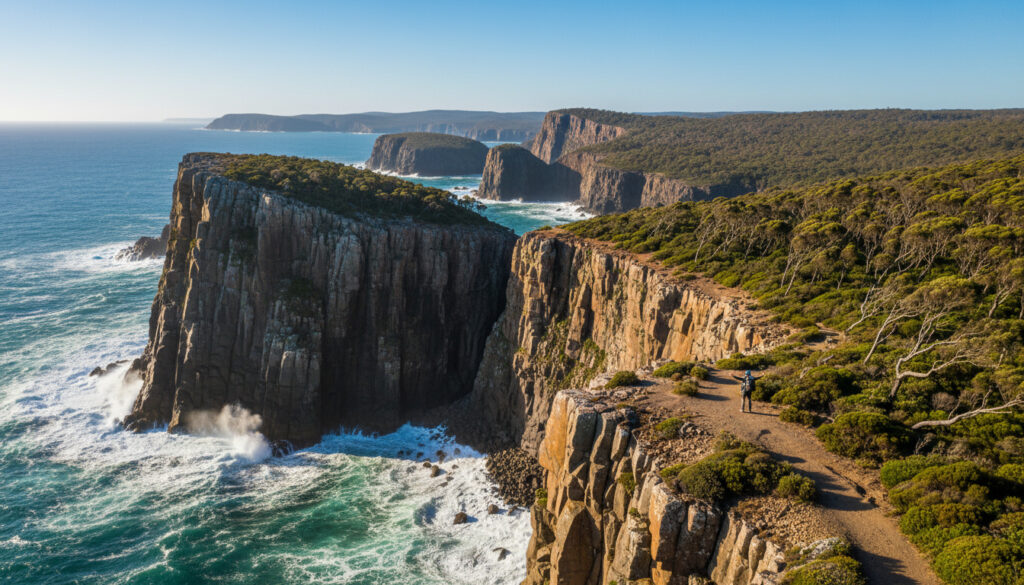
The Three Capes Track delivers a 48-kilometer coastal journey across Tasmania’s Tasman Peninsula, revealing Australia’s highest sea cliffs through a meticulously engineered trail. Opened in 2015 within Tasman National Park, this four-day, one-way hike connects Denmans Cove to Fortescue Bay via three purpose-built huts, eliminating the need for tents while offering dramatic views of Cape Pillar, Cape Hauy, and Cape Raoul.
Unlike rugged backcountry routes, this track features wide, dry-boot-standard pathways of gravel, stone, and timber boardwalks designed for two hikers to walk abreast. The experience begins with a 75-minute boat cruise from the Port Arthur Historic Site and concludes with a bus transfer from Fortescue Bay, creating a seamless linear journey through diverse ecosystems ranging from tall eucalypt forests to exposed dolerite cliffs.
Construction of the trail required significant engineering, including 18,000 helicopter flights to establish 35 kilometers of new track without damaging the sensitive coastal environment. The result accommodates a broad range of fitness levels, though the 19-kilometer third day and cumulative elevation changes demand solid preparation.
What is the Three Capes Track?
The track represents a significant investment in accessible wilderness tourism, offering a hut-based hiking experience unique to Australian national parks.
- Opened in 2015 after extensive aerial construction work
- Three reserved huts provide overnight shelter without camping gear
- Includes boat transfer from Port Arthur and return bus transport
- Self-guided pass includes 2-year entry to Port Arthur Historic Site
- Engineered to “dry-boot” standard with minimal mud
- Wide trails accommodate two hikers walking side-by-side
- Passes through Tasman National Park with highest sea cliffs in Australia
| Attribute | Specification |
|---|---|
| Track Length | 48km one-way |
| Total Duration | 4 days / 3 nights |
| Located In | Tasman National Park |
| Year Opened | 2015 |
| Hut Capacity | 48 beds total across three huts |
| Cumulative Elevation | Approximately 1,700m |
| Guiding Standard | Self-guided (guided options available) |
| Start Point | Denmans Cove (boat from Port Arthur) |
| End Point | Fortescue Bay |
| 2024 Self-Guided Price | AUD $595 per person |
Three Capes Track Itinerary and Daily Breakdown
The standard itinerary spans four distinct days, each ending at a designated hut with reserved bedding. Daily distances vary significantly, with the third day presenting the greatest physical challenge.
The Standard Self-Guided Route
Day One: The journey begins at Denmans Cove after a scenic boat transfer from Port Arthur Historic Site. Hikers cover 4 kilometers in approximately 1 to 1.25 hours to reach Surveyors Hut, passing initial views of Cape Raoul and the waters of Surveyors Cove.
Day Two: From Surveyors Hut to Munro Hut, trekkers travel 11 kilometers over 3.75 to 6 hours. This section traverses diverse terrain including Crescent Bay, Arthur’s Peak, and dense rainforests where echidnas frequently appear near the trail. The route descends into Munro Bight before reaching the second hut.
Day Three: The longest and most demanding section runs 19 kilometers from Munro Hut to Retakunna Hut via Cape Pillar. Taking 5.25 to 8 hours, this day features the track’s most dramatic scenery including the 300-meter Cape Pillar cliffs, The Blade (a narrow dolerite ridge), and Cathedral Rock. The distance and pack weight make this the crucible of the hike.
Day Four: The final 14-kilometer leg from Retakunna to Fortescue Bay via Cape Hauy requires roughly 5.75 hours. Hikers summit Mt Fortescue before reaching Cape Hauy’s lookout over the Totem Pole and Candlestick rock formations. The track ends at Fortescue Bay, where a return bus awaits.
Guided and Luxury Alternatives
Commercial operators modify the standard route for different experience levels. Park Trek offers a 35-kilometer version graded 3-4 (moderate to more difficult) where hikers carry only day packs, staying in alternative accommodations. The Tasmanian Walking Company operates a 53-kilometer fully guided experience featuring private lodges instead of huts, with additional cruising components and premium pricing starting around AUD $2,000 per person.
Self-guided hikers must carry full packs including food and sleeping gear between huts, while guided options provide lodge accommodation and transport daypacks only. Both options require the same boat transfer from Port Arthur.
Difficulty Level and Fitness Requirements
The Three Capes Track earns its “easy-moderate” rating primarily through engineering rather than terrain. However, the cumulative physical demands should not be underestimated, particularly for inexperienced hikers.
Trail Engineering and Surface Conditions
Pathways consist of compacted gravel, stone pitches, timber boardwalks, and constructed steps. The “dry-boot” design drains effectively, allowing passage during wet weather without the deep mud typical of Tasmanian trails. Boardwalks protect sensitive vegetation while providing stable footing.
Physical Demands and Pack Weight
While daily distances appear modest, the third day’s 19-kilometer stretch with a full pack tests endurance. Cumulative elevation gain across four days approaches 1,700 meters, with repeated ascents and descents. Trail reports suggest that youth or strong legs significantly improve comfort levels, though the track accommodates various ages and abilities.
Coastal Hazards and Exposure
The track runs along cliffs exposed to the Southern Ocean. Wind gusts reaching 170 kilometers per hour have been recorded on Cape Pillar. Crucially, Parks Tasmania notes that no barriers exist near cliff edges in many sections. Hikers must maintain situational awareness during high winds and avoid protruding ledges during gusty conditions.
Costs, Booking, and How to Reserve
Access to the Three Capes Track operates through a permit system with mandatory reservations. Understanding the pricing structure and booking timeline proves essential for securing preferred dates.
Pricing Structure and Inclusions
The self-guided Three Capes Track Pass costs AUD $595 per person based on 2024 rates. This fee includes the four-day walking permit, three nights in reserved huts, the Pennicott Wilderness Journeys boat transfer from Port Arthur to Denmans Cove, and the return bus from Fortescue Bay. The pass also includes a two-year entry permit to the Port Arthur Historic Site. Budget travelers should note that free alternatives exist via day hikes to individual capes, bypassing overnight fees but requiring vehicle logistics.
Reservation Process and Transport
Bookings are mandatory and processed exclusively through the Tasmania Parks and Wildlife Service website. The journey begins with check-in at the Port Arthur Historic Site, followed by the 75-minute boat cruise to the trailhead. Official sources emphasize booking months in advance due to high demand, particularly for summer departures. Arriving at Port Arthur requires approximately 1.5 hours driving from Hobart; hikers may need to arrange car service near me for vehicle transport or shuttle connections.
The track closes annually for maintenance and burn operations. In 2025, the closure runs from 28 April to 11 May, affecting sections from Denmans Cove to Cape Hauy and the Old Cape Pillar Track. No permits are available during these dates.
The AUD $595 fee covers boat transfer, bus return, hut accommodation, and Park entry. Food and personal equipment are not provided. Huts contain water tanks, cooking platforms, and mattresses, but hikers must carry food and cooking systems.
The Four-Day Journey: A Daily Timeline
-
Day 1: Denmans Cove to Surveyors Hut
Begin with the Pennicott boat cruise from Port Arthur Historic Site. Short walk to Surveyors Hut with views of Cape Raoul across the water. Source: Brooke Beyond
-
Day 2: Surveyors to Munro
Traverse Crescent Bay and Arthur’s Peak through tall eucalypt and rainforest. Wildlife sightings including echidnas common. Overnight at Munro Hut overlooking Munro Bight. Source: NOMADasaurus
-
Day 3: Munro to Retakunna via Cape Pillar
The challenging traverse to Cape Pillar cliffs and The Blade. Exposed sections with 170km/hr wind potential. Cathedral Rock and dolerite columns highlight the route. Source: Cruisin Chronicles
-
Day 4: Retakunna to Fortescue Bay via Cape Hauy
Summit Mt Fortescue before reaching Cape Hauy lookout. Views of the Totem Pole and Candlestick sea stacks. Descend to Fortescue Bay for swimming and bus transfer. Source: Brooke Beyond
Certainties and Variables in Planning
| Established Information | Uncertain Variables |
|---|---|
| The track measures exactly 48km from Denmans Cove to Fortescue Bay | Specific weather conditions on any given day remain unpredictable despite forecasts |
| Three huts provide 48 beds total with reserved sleeping platforms | 2025 pricing updates beyond the current AUD $595 rate have not been confirmed |
| The track closes 28 April–11 May 2025 for scheduled maintenance | Last-minute booking availability fluctuates based on cancellations |
| Summer months (Dec–Feb) historically provide milder conditions | Exact wind speeds at cliff edges vary hourly and seasonally |
When is the Best Time to Hike the Three Capes Track?
Coastal weather on the Tasman Peninsula changes instantaneously regardless of season, though statistical patterns favor the summer months from December through February. During this window, temperatures moderate and daylight extends, though hikers must still prepare for rain and wind. Parks Tasmania emphasizes that the track remains open year-round except for the scheduled maintenance closure, but conditions demand quality waterproof gear and layering systems in any month.
The 2025 closure from 28 April to 11 May affects the Denmans Cove to Cape Hauy section and Old Cape Pillar Track for fuel-reduction burns and infrastructure maintenance. Beyond this period, the track operates continuously, though winter hiking introduces shorter days and higher probability of severe weather delays. Checking daylight savings transitions helps plan daily hiking hours during autumn and spring departures.
Wind represents the primary environmental hazard, with unprotected cliff edges subject to gusts exceeding 100km/hr even during mild seasons. Hikers should verify marine forecasts specifically for the Tasman Peninsula rather than general Hobart predictions, as local conditions diverge significantly from inland weather patterns.
What Hikers and Officials Say
One of Australia’s best hikes. The scenery is world-class, the engineering is impressive, and the views live up to the hype.
— NOMADasaurus, experienced hiking guides
Awesome trek, well-designed track. The huts are basic but provide exactly what you need after a long day on the trail.
— TripAdvisor review, 2024
The track represents a new standard for accessible wilderness experiences. The dry-boot engineering allows people to focus on the dramatic coastal scenery rather than navigating mud.
— Cruisin Chronicles, travel journalism
How to Start Planning Your Hike
Begin by securing your permit through the official Parks Tasmania website several months before your intended departure, particularly for summer slots. Condition yourself specifically for the third day’s 19-kilometer distance with elevation gain while carrying a loaded pack. Monitor the daylight savings schedule to maximize hiking hours, and arrange your car service near me or transport to Port Arthur well in advance. With preparation complete, the Three Capes Track offers a engineered wilderness experience balancing accessibility with raw coastal grandeur.
Frequently Asked Questions
Is the Three Capes Track suitable for beginners?
The engineered trails suit beginners with solid fitness, though the 19km Day 3 and pack weight challenge novices. Prior multi-day hiking experience helps, but the dry-boot standard and hut accommodation lower barriers compared to traditional Tasmanian tracks.
Are dogs allowed on the Three Capes Track?
No. Domestic animals are prohibited in Tasman National Park to protect wildlife including echidnas and native birds. Assistance animals may have specific exemptions pending park approval.
What happens if it rains on the Three Capes Track?
The track remains open during rain. The engineered surface drains effectively, maintaining dry-boot conditions in all but extreme downpours. Huts provide covered cooking areas and sleeping quarters regardless of weather.
Can you do the Three Capes Track in one day?
Completing the full 48km in one day is not practical or permitted under standard bookings. However, individual capes like Cape Hauy and Cape Raoul are accessible via separate day hikes from Fortescue Bay and other trailheads without overnight permits.
What should I pack for the Three Capes Track?
Essentials include waterproof jacket and pants, warm layers, sturdy boots, sleeping bag, cooking equipment, and four days of food. Huts provide mattresses and water tanks but no bedding or cooking facilities. Sun and wind protection are critical for exposed cliff sections.
How far in advance should I book?
Book three to six months ahead for summer departures (December–February). Shoulder seasons offer more flexibility, but the track’s popularity means last-minute availability is rare.
Are there any age restrictions for the Three Capes Track?
No official age restrictions exist, but hikers under 18 must be accompanied by an adult. The physical demands and cliff exposure require children to have proven endurance and reliable hazard awareness.
More related posts
 Toronto Blue Jays vs Dodgers Match Player Stats: Latest Games
 What Is Ozempic? Uses, Side Effects & Weight Loss Facts
 Nelson Asofa-Solomona: From NRL to Undefeated Boxer
 Nina Dobrev: Age, Husband, Health Condition, and Relationships
 Jamarra Ugle-Hagan: Mental Health Leave, Trade to Suns
 Dakota Johnson Movies: Her Filmography & Personal Life
 In to CM – Conversion Chart, Exact Formula & Guide
 Latest Royal News: Today’s Updates on the British Monarchy
