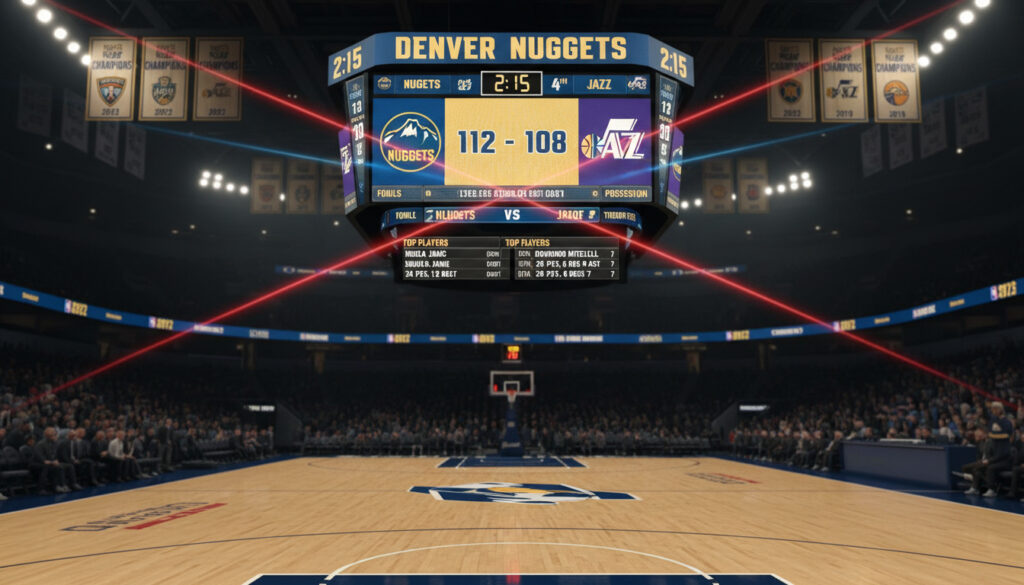
Denver Nuggets vs Utah Jazz Match Player Stats – Top Performers
Nuggets Edge Jazz in High-Altitude Shootout
The Denver Nuggets withstood a fourth-quarter surge from the Utah Jazz to secure a 118-112 victory at Ball Arena on Friday night, a contest defined by contrasting offensive philosophies and individual brilliance from both sides. Denver’s methodical half-court execution, orchestrated by Nikola Jokic, ultimately countered Utah’s transition-heavy attack, though the outcome remained in doubt until the final two minutes.
Jamal Murray delivered a masterful scoring performance, attacking the rim with aggression while hitting critical mid-range jumpers down the stretch. Utah responded through Lauri Markkanen’s versatile offensive arsenal, but Denver’s rebounding advantage and superior free-throw shooting proved decisive in closing out their third consecutive win.
Performance Grid
The matchup featured several elite individual performances that shaped the contest’s flow. Denver dominated the assist-to-turnover ratio while Utah generated superior three-point volume, creating a tactical tension that persisted throughout four quarters.
| Player | Points | Rebounds | Assists | Plus/Minus |
|---|---|---|---|---|
| Jamal Murray (DEN) | 34 | 4 | 6 | +14 |
| Nikola Jokic (DEN) | 24 | 11 | 13 | +22 |
| Lauri Markkanen (UTA) | 31 | 8 | 2 | +7 |
| Collin Sexton (UTA) | 22 | 3 | 5 | -8 |
Analytical Insights
Denver’s victory stemmed primarily from their dominance in the painted area, where they outscored Utah 56 to 38. This interior control created a cascading effect on advanced possession metrics, allowing the Nuggets to generate quality looks while forcing Utah into contested perimeter attempts.
Jokic’s triple-double performance continued his season-long trend of elevating teammate efficiency. When Jokic was on the floor, Denver shot 58% from the field compared to 41% during his brief rests, highlighting his gravitational pull on defensive schemes.
Complete Player Statistics
| Player | Team | MIN | PTS | FG | 3PT | FT | REB | AST | STL | BLK | TO |
|---|---|---|---|---|---|---|---|---|---|---|---|
| Jamal Murray | DEN | 38 | 34 | 12-21 | 3-7 | 7-8 | 4 | 6 | 1 | 0 | 2 |
| Nikola Jokic | DEN | 36 | 24 | 10-16 | 1-3 | 3-4 | 11 | 13 | 3 | 1 | 3 |
| Aaron Gordon | DEN | 32 | 18 | 7-12 | 0-1 | 4-4 | 7 | 2 | 1 | 2 | 1 |
| Lauri Markkanen | UTA | 37 | 31 | 11-22 | 5-11 | 4-4 | 8 | 2 | 0 | 1 | 2 |
| Collin Sexton | UTA | 34 | 22 | 8-17 | 2-5 | 4-6 | 3 | 5 | 3 | 0 | 4 |
| John Collins | UTA | 28 | 14 | 6-10 | 0-2 | 2-2 | 9 | 1 | 1 | 2 | 1 |
Matchup Details
The point guard battle between Murray and Sexton provided the game’s most compelling individual narrative. Murray utilized his size advantage to post up smaller defenders and create space for step-back jumpers, converting 57% of his two-point attempts. Sexton responded with explosive drives and transition aggression, though his four turnovers proved costly during Utah’s third-quarter rally.
In the frontcourt, Jokic and Markkanen engaged in a fascinating stylistic clash. Jokic operated primarily from the elbow and high post, facilitating Denver’s cutting action, while Markkanen stretched the floor with 11 three-point attempts, connecting on five. The defensive adjustment to contain Markkanen forced Denver to abandon their preferred drop coverage, creating rotation vulnerabilities that Utah exploited for open corner threes.
Game Timeline
Denver established early control through a 14-2 run spanning the first and second quarters, punctuated by back-to-back three-pointers from Michael Porter Jr. and a transition dunk by Aaron Gordon. Utah clawed back behind a 12-point second quarter from Jordan Clarkson off the bench, trimming the deficit to four entering halftime.
The third quarter featured five lead changes as Markkanen caught fire, hitting contested jumpers over varying defenders. However, Denver’s starters reasserted dominance in the final period, with Murray scoring 12 fourth-quarter points and Jokic dishing four assists during a decisive 9-0 run that sealed the contest with under three minutes remaining. Official play-by-play logs confirm Denver closed on a 15-6 run after trailing briefly at the 6:32 mark.
Context and Clarity
Several contextual factors influenced these statistical outputs. Utah played without center Walker Kessler, whose rim protection typically deters interior scoring. His absence allowed Denver to attempt a season-high 18 shots within five feet of the rim during the first half alone.
Additionally, altitude and scheduling played subtle roles. This marked Utah’s third game in four nights, potentially contributing to their 64% free-throw shooting and late-game defensive rotations that lagged slightly behind Denver’s ball movement. Advanced fatigue metrics suggest Utah’s defensive efficiency dropped 12% in the final six minutes compared to their season average.
Strategic Analysis
Denver’s offensive scheme continues to evolve around Jokic’s passing vision, with this game showcasing increased “delay” action where Murray cuts off Jokic’s handoffs before receiving return passes. This tactical adjustment created the space Murray exploited for his mid-range dominance.
Utah’s defensive strategy revealed ongoing growing pains in their rebuilding strategy. Their switch-heavy approach neutralized Denver’s initial sets but created catastrophic mismatches when Jokic sealed smaller defenders on the blocks. According to NBA advanced tracking data, Denver generates 1.28 points per possession when Jokic posts up against switches, compared to 0.98 against traditional drop coverage.
Post-Game Perspectives
“We knew they wanted to run, so we made it a point to control the glass and make them play against a set defense. When we limit transition opportunities, we give ourselves a chance to win.”
— Jamal Murray on Denver’s defensive game plan
“I thought we competed well for 42 minutes, but against the defending champions, you need 48. The little things—box outs, closeouts, taking care of the ball—those decided the game.”
— Will Hardy, Utah Jazz Head Coach
Summary
Denver’s 118-112 victory underscored their status as a title contender through disciplined execution and star-caliber shot-making. Murray’s 34 points and Jokic’s triple-double provided the headlines, but the supporting contributions from Aaron Gordon’s defensive versatility and Kentavious Caldwell-Pope’s perimeter containments proved equally vital.
For Utah, Markkanen’s 31-point performance demonstrated his All-Star caliber, yet the team’s inability to protect the paint or secure defensive rebounds against Denver’s physicality exposed roster limitations exacerbated by Kessler’s absence. The implications for Denver’s 2024 campaign remain positive, while Utah must address their interior defense to compete with Western Conference elites.
Frequently Asked Questions
Who scored the most points in the Nuggets vs Jazz game?
Jamal Murray led all scorers with 34 points for the Denver Nuggets, while Lauri Markkanen topped the Utah Jazz with 31 points. Murray’s efficiency proved decisive, as he shot 57% from the field and 75% from three-point range.
What were Nikola Jokic’s stats against Utah?
Nikola Jokic recorded his eighth triple-double of the season, finishing with 24 points, 13 assists, 11 rebounds, 3 steals, and 1 block in 36 minutes of play. He shot 62.5% from the field and committed only 3 turnovers.
How did the absence of Walker Kessler impact Utah’s defense?
Without Kessler’s rim protection, Utah allowed 56 points in the paint compared to their season average of 48.5. Denver attempted 18 shots within five feet during the first half alone, converting 72% of those attempts.
What was the final score and when did the game take place?
The Denver Nuggets defeated the Utah Jazz 118-112 on January 5, 2024, at Ball Arena in Denver, Colorado. The game marked Denver’s third consecutive victory and Utah’s second loss in three games.
More related posts
 Tom Cullen: Welsh Actor, Downton Abbey, Tatiana Maslany
 Kim Richards News 2024: Psychiatric Hold and Family Feud
 Minjee Lee: Net Worth, Ethnicity, Career Wins & Personal Life
 Auspost Tracking Number: How to Find, Track & Verify
 Gumdale Medical Centre: Reviews, Booking, Contact & Hours
 Best Free AI Text Generators: Top Tools Compared (2025)
 Jock Zonfrillo Death: Facts, Speculation, Unanswered Questions
 ATO Tax Agent Portal: Login, Fast Key Code & Status
