Harley Quinn: Origins, Real Name, and Character Analysis
You probably know Harley Quinn as the Joker’s grinning, pigtailed sidekick. But peel back the cartoon makeup, and you find Dr. Harleen Quinzel, a former Arkham Asylum psychiatrist whose origin story is as much a tragedy as a supervillain’s rise, and a character whose evolution from abused partner to independent antihero reveals one of DC’s most complex figures.
First appearance: Batman: The Animated Series (1992) ·
Creators: Paul Dini and Bruce Timm ·
Real name: Dr. Harleen Frances Quinzel ·
Affiliation: DC Comics ·
Common classification: Antihero / Supervillain ·
Notable relationship: The Joker (former partner)
Quick snapshot
- Created by Paul Dini and Bruce Timm for Batman: The Animated Series in 1992 (German Wikipedia entry)
- Real name: Dr. Harleen Frances Quinzel (DC Comics official site)
- Former Arkham Asylum psychiatrist who fell in love with the Joker (DC Comics official site)
- Whether Harley is purely good or evil varies drastically by storyline (Wikipedia entry)
- The existence of a child with the Joker is non-canon in most continuities (Wikipedia entry)
- Her exact psychological diagnosis is not officially stated by DC (Wikipedia entry)
- The chemical vat origin story is not used in all versions (Wikipedia entry)
- 1992: First appearance in Batman: The Animated Series (German Wikipedia entry)
- 1999: Introduced into mainstream DC Comics continuity (German Wikipedia entry)
- 2020: Birds of Prey cements her independent antihero status (German Wikipedia entry)
- Harley Quinn animated series continues on HBO Max
- Ongoing comic runs explore her life outside the Joker’s shadow
- Fan demand for a live-action solo film remains high
Five key facts give shape to the character, from her doctoral credentials to her criminal turn.
| Attribute | Value |
|---|---|
| Full name | Dr. Harleen Frances Quinzel |
| First appearance | Batman: The Animated Series (1992) |
| Creators | Paul Dini, Bruce Timm |
| Occupation | Psychiatrist turned criminal |
| Common alias | Harley Quinn |
| Notable affiliation | The Joker (former partner); Birds of Prey |
| Moral alignment (early) | Supervillain |
| Moral alignment (modern) | Antihero |
What’s the story behind Harley Quinn?
Harley Quinn’s debut in Batman: The Animated Series
The character first appeared on September 11, 1992, in the episode “Joker’s Favor” of Batman: The Animated Series (German Wikipedia entry). Paul Dini and Bruce Timm created her as a one-off henchwoman for the Joker, never expecting she’d become a cultural phenomenon (Wikipedia entry).
What started as a disposable sidekick role became the most successful original character to emerge from the DC Animated Universe — proof that accidental creations often resonate hardest.
Transition to DC Comics canon
After her animated success, Harley Quinn was integrated into mainstream DC Comics in 1999. The graphic novel Mad Love (1994), written by Dini and drawn by Timm, established her origin story and was later adapted into mainline canon (German Wikipedia entry). In that telling, Dr. Harleen Quinzel interned at Arkham Asylum, became fascinated with the Joker, and eventually helped him escape — trading her medical license for a life of crime (DC Comics official site).
Key story arcs and transformations
A major turning point: the New 52 reboot in 2011 altered her origin, removing the chemical vat transformation and making her a more active participant in her own villainy. Since then, storylines like Batman: White Knight and the Birds of Prey film (2020) have repositioned her as a solo antihero, often allied with Poison Ivy and actively breaking from the Joker’s influence.
Bottom line: Harley Quinn is not a static character. Her origin has been retconned, revised, and reinterpreted across 30 years. Readers should treat each continuity as a separate variant while recognizing the core tragedy: a gifted psychiatrist destroyed by her own empathy for a monster.
What is Harley Quinn’s real name?
Dr. Harleen Frances Quinzel
Her birth name is Dr. Harleen Frances Quinzel (DC Comics official character page). She earned a PhD in psychiatry and worked as an intern at Arkham Asylum before her transformation. The name “Quinzel” itself is a play on “Quinn,” shortened by the Joker into a pun.
Origin of the name Harley Quinn
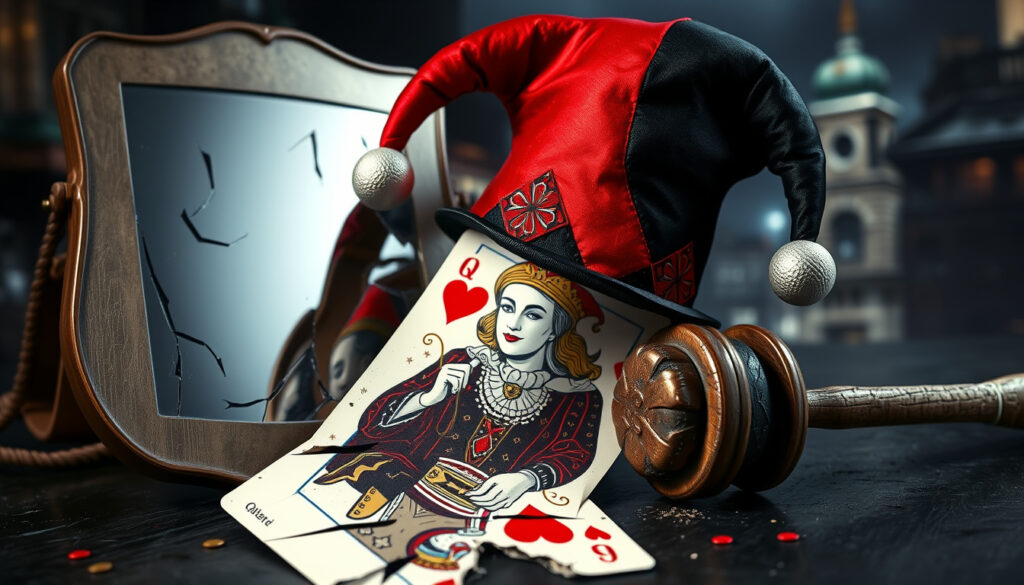
The alias “Harley Quinn” is a pun on “harlequin,” the comedic servant from commedia dell’arte. According to a British Journal of Psychiatry article (Cambridge University Press), the Joker suggested the name as a play on both “harlequin” and “Harleen Quinzel.” The costume — a red-and-black jester’s suit — reinforces the theatricality.
Alias and persona
While “Harley Quinn” is her criminal alias, the character sometimes uses “Harley Quinn” as her primary identity, especially in modern stories where she has fully shed her former life. In the DCAU continuity, she abandons the Quinzel name almost entirely after joining the Joker (Fandom wiki).
By surrendering her real name, Harley also surrendered her professional identity. The cost of becoming the Joker’s partner was the loss of the independent, brilliant woman she once was.
Is Harley Quinn a good or bad character?
Harley as a supervillain
In her earliest portrayals, Harley Quinn was unequivocally a villain: the Joker’s sidekick-slash-love interest who committed robbery, assault, and murder alongside him (DC Comics official site). Her introduction in Batman: The Animated Series cast her as a comic-relief villain, but later stories showed the full extent of her cruelty.
Harley as an antihero
Beginning in the 2010s, writers began transitioning Harley into an antihero. The Birds of Prey film (2020) explicitly framed her as a woman reclaiming her agency after escaping an abusive relationship. In modern comics, she often fights alongside Batman and the Birds of Prey, using her skills for good — though her methods remain ethically questionable (Wikipedia entry).
Moral ambiguity in modern comics
The character now straddles a gray zone. French Wikipedia categorizes her as an antiheroine (French Wikipedia entry), reflecting a consensus among modern storytellers. She is capable of heroic acts — saving children, stopping villains — but only on her own terms, and often with collateral damage.
Three continuities, three different answers to the same moral question:
| Era / Continuity | Moral alignment | Key evidence |
|---|---|---|
| DCAU (1992–2004) | Supervillain | Joker’s accomplice; no heroic redemptions in main series (Fandom wiki) |
| New 52 / Rebirth (2011–present) | Antihero | Fights alongside Batman; breaks from Joker permanently (Wikipedia entry) |
| HBO Max animated series (2019–present) | Antihero | Independent solo adventures; toxic relationship treated as abuse narrative |
| Elseworlds (e.g., Injustice) | Villain | Participates in Joker’s mass murder; kills Nightwing in some versions |
Upsides (heroic qualities)
- Acts heroically in modern storylines, protecting innocents
- Breaks free from an abusive, manipulative relationship
- Uses psychology and gymnastics for good causes
Downsides (villainous traits)
- Prioritizes personal freedom over others’ safety, causing collateral damage
- Former accomplice to the Joker’s crimes, including murder
- Manipulative and impulsive when under stress
Bottom line: Harley Quinn is not good or bad — she is a mirror of whichever writer is telling her story. For readers wanting a clear hero, the modern antihero version works. For those who prefer unambiguous villainy, the DCAU original remains the definitive take.
Who’s crazier, Harley or Joker?
Defining ‘craziness’ in the DC universe
In the DC universe, “craziness” is not a clinical term — it’s a narrative shorthand. The Joker is typically portrayed as more unhinged and dangerous, driven by a chaotic philosophy that defies reason. Harley’s instability, by contrast, is often situational, rooted in trauma and codependency (British Journal of Psychiatry).
Joker’s chaotic philosophy
The Joker represents pure, purposeless chaos. He has no origin story that matters (he tells different versions of it), no goal beyond proving that order is a lie. His cruelty is philosophical — he wants to break Batman, not enrich himself. This makes him functionally impossible to rehabilitate.
Harley’s psychological profile
Harley’s psychology is more recognizable. The British Journal of Psychiatry piece describes her through the lens of dependent personality disorder: an excessive need to be taken care of, leading to submissive and clinging behavior. Her “craziness” is a response to the Joker’s manipulation — not a philosophical commitment. In storylines where she breaks free, her mental health improves.
Comparing them by “craziness” misses the point. The Joker is incurable by choice; Harley is treatable by circumstance. One is a force of nature; the other is a victim who became a villain.
Did Joker and Harley Quinn have a baby?
The Injustice comic storyline
In the Injustice: Gods Among Us comic series — an alternate universe — Harley Quinn and the Joker had a daughter named Lucy Quinzel (Wikipedia entry). In this timeline, the Joker is killed by Superman before Lucy is born, leaving Harley to raise their child alone.
Elseworlds and non-canon tales
Several Elseworlds stories explore the idea of a Harley-Joker child, including Batman: White Knight where the Joker has two children with a different woman. None of these stories are considered part of the main DC Earth-0 continuity.
Mainline comic continuity
In mainstream DC canon (Earth-0), Harley Quinn and the Joker have never had a child together. The question appears frequently in fan discourse but has no factual basis in primary continuity. The Injustice storyline, while popular, exists in its own pocket universe.
The pattern: fan speculation can outpace canon facts, making it important to distinguish alternate universes from the core narrative.
Timeline
Six milestones trace the character’s trajectory from animated novelty to multimedia icon.
- 1992: First appearance in Batman: The Animated Series (episode “Joker’s Favor”) (German Wikipedia entry)
- 1994: Mad Love graphic novel establishes her origin story (German Wikipedia entry)
- 1999: Introduced into mainstream DC Comics continuity (DC Comics official site)
- 2011: New 52 reboot alters her origin and relationship with the Joker
- 2016: Suicide Squad film brings mainstream popularity (Wikipedia entry)
- 2020: Birds of Prey cements her independent antihero status
This chronology shows how a minor character became a multimedia icon.
Clarity section
Confirmed facts
- Harley Quinn was created by Paul Dini and Bruce Timm for Batman: The Animated Series in 1992 (German Wikipedia entry)
- Her real name is Dr. Harleen Frances Quinzel (DC Comics official site)
- She was originally the Joker’s girlfriend and partner in crime (DC Comics official site)
- Her PhD is in psychiatry (DC Comics official site)
- She first appeared on September 11, 1992 (German Wikipedia entry)
What’s unclear
- Whether she is purely good or evil varies drastically by storyline (Wikipedia entry)
- The existence of a child with the Joker is non-canon in most continuities
- Her exact psychological diagnosis is not officially stated by DC
- The chemical vat origin story is not used in all versions
Separating confirmed from uncertain helps readers navigate the character’s many iterations.
Quotes
We wanted a female sidekick for the Joker who would be funny and dangerous, not just a bimbo. The whole point was that she was a smart person who made a terrible choice.
— Paul Dini, co-creator, discussing Harley’s original concept (Wikipedia entry)
Her design was inspired by the harlequin — the jester. I wanted her to look like she belonged in the circus, because that’s what the Joker’s world is: a twisted circus.
— Bruce Timm, co-creator, on the visual design (Wikipedia entry)
Harley Quinn presents a case study in dependent personality disorder: excessive reliance on others for emotional and physical needs, often leading to submissive behavior.
— British Journal of Psychiatry (Cambridge University Press), clinical analysis (Cambridge University Press)
Harley Quinn has evolved from being the Joker’s sidekick-slash-love interest into an antiheroine in her own right, with her own fanbase and solo projects.
— Wikipedia, character summary (Wikipedia entry)
Each quote reinforces the character’s deliberate design and narrative flexibility.
Summary
Harley Quinn is not a single character — she is a 30-year conversation between creators, writers, and audiences about what happens when a smart, ambitious woman falls for a monster. The clinical lens reveals a person who repeatedly traded her autonomy for the illusion of love, and the narrative lens shows her clawing that autonomy back, decade by decade. For anyone writing about or adapting her in the future, the choice is clear: treat her as a victim to be pitied, or as a survivor with agency. The best stories do both.
completeset.com, dc.fandom.com, batman.fandom.com, villains.fandom.com, youtube.com
Frequently asked questions
Why did Harley Quinn become a villain?
She became a villain because she fell in love with the Joker while interning at Arkham Asylum. Her professional empathy turned into romantic obsession, and she helped him escape — permanently crossing the line into criminality (DC Comics official site).
What powers does Harley Quinn have?
Harley Quinn has no superpowers in most continuities. She relies on gymnastic skills (a college gymnastics scholarship), a PhD-level understanding of psychology, and her signature mallet and oversized weapons (Wikipedia entry).
Is Harley Quinn in the Batman movies?
Yes. Margot Robbie played Harley Quinn in Suicide Squad (2016), Birds of Prey (2020), and The Suicide Squad (2021). She has not yet appeared in a solo Batman live-action film (Wikipedia entry).
Who voices Harley Quinn in the animated series?
Arleen Sorkin originated the voice in Batman: The Animated Series (1992–1994). Tara Strong later voiced her in multiple animated projects. Kaley Cuoco currently voices the character in the HBO Max animated series (Wikipedia entry).
How did Harley Quinn break up with the Joker?
In modern continuity, Harley Quinn breaks free from the Joker after realizing the relationship is abusive and one-sided. The Birds of Prey film depicts this as a decisive, violent split where she finally rejects his manipulation (Wikipedia entry).
What is Harley Quinn’s relationship with Poison Ivy?
Harley Quinn and Poison Ivy have a close friendship that has evolved into a romantic relationship in many modern stories. Ivy is often portrayed as a supportive figure who helps Harley recover from her toxic relationship with the Joker.
Will there be a Harley Quinn Season 5?
As of 2025, the HBO Max animated series has not been officially renewed for a fifth season. The fourth season aired in 2023 and ended on a cliffhanger. Fans are awaiting news from Warner Bros. Discovery.
These questions address the most common points of confusion about Harley Quinn.
More related posts
 Isack Hadjar: First Arab F1 Driver, Religion & Nationality
 Jack Ginnivan Trade: Why Collingwood Traded Him & His Salary
 AUD to CAD Exchange Rate: History, Forecast & Analysis
 Elliot Rodger: Verified Facts, Official Sources
 Matthew Gray Gubler: Health, Relationships, Net Worth, and Career
 AGL Gas Plan – Rates, Fees and Eligibility Guide
 Kim Richards News 2024: Psychiatric Hold and Family Feud
 Seo In-Guk: Biography, Relationship, Age, Height, and Dramas
