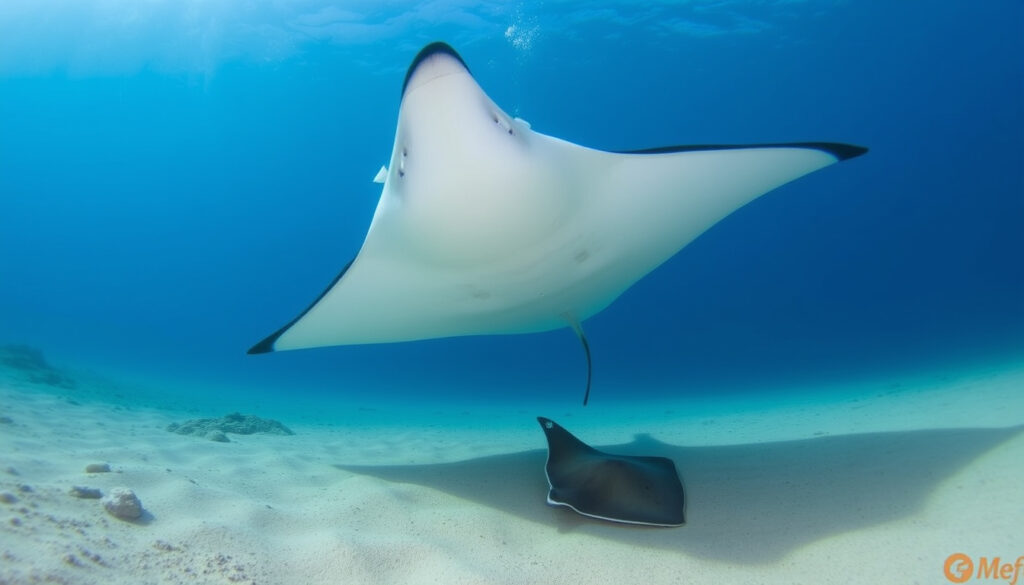
Manta Ray Facts: Safety, Behavior, and Stingray Differences
Manta rays glide through the water with an otherworldly grace, yet behind that serene motion lies a biological reality that demands respect, not fear. These gentle giants, with wingspans exceeding a small car, are more likely to inspire awe than alarm—but knowing why touching one harms it, how it differs from a stingray, and what its conservation status means for our encounters has never been more critical.
Maximum wingspan: Up to 26 ft (8 m) for giant oceanic manta ·
Maximum weight: Approximately 1,350 kg (2,980 lb) ·
Diet: Zooplankton (filter feeder) ·
Conservation status: Vulnerable (IUCN Red List) ·
Average lifespan: Up to 50 years
Quick snapshot
- Manta rays have no stinger and cannot sting (William Drumm)
- They are filter feeders that consume zooplankton (NOAA Fisheries)
- Giant oceanic manta is the world’s largest ray, wingspan up to 26 ft (NOAA Fisheries)
- No recorded fatal attack on a human (Kona Snorkel Trips)
- Exact lifespan in the wild – estimates range from 20 to 50 years
- Taxonomy of Mobula species – some sources still recognize only two main species
- Impact of specific human activities on local populations
- 2011 – Manta rays protected in international waters under the Convention on Migratory Species (National Geographic)
- 2018 – Giant manta ray listed as threatened under the U.S. Endangered Species Act (NOAA repository)
- 2022 – NOAA publishes new migration tracking study (NOAA Fisheries)
- Population monitoring under ESA recovery plan
- Expansion of responsible eco-tourism guidelines
- Further research on bycatch mitigation and habitat protection
| Scientific name | Mobula birostris (giant oceanic), Mobula alfredi (reef) |
| Class | Chondrichthyes (cartilaginous fish) |
| Diet | Zooplankton, small crustaceans, fish larvae |
| Predators | Large sharks (tiger shark, great hammerhead), orcas |
| Conservation status | Vulnerable (IUCN Red List) |
| Population trend | Decreasing |
Why can’t we touch manta rays?
What happens if you touch a manta ray?
- Manta rays have a protective mucus coating that guards against infections and parasites. Touching strips away this layer, leaving the skin vulnerable to bacteria and disease, as explained by Sea Quest Hawaii.
- Human contact also triggers a stress response in the animal, raising its heart rate and causing it to flee – a waste of energy that could be used for feeding or migration.
Is it dangerous to touch a manta ray?
For the swimmer, the risk is minimal – manta rays have no venom and no stinger. The real danger is to the manta. In Hawaiian waters it is illegal to touch, chase, ride, or harass them. Breaking these rules can result in fines and further stress to an already vulnerable species.
Why do manta rays have a protective mucus layer?
Like many fish, manta rays secrete a thin layer of mucus that acts as a physical and chemical barrier. This coating contains antimicrobial enzymes and lubricates the skin to reduce drag while swimming. Removing it by touch compromises the animal’s first line of defense, opening the door to infection. Marine biologists from NOAA Fisheries emphasize that even a gentle stroke can cause lasting harm.
A single touch may seem harmless, but for a manta ray that encounters hundreds of swimmers each year, the cumulative damage can reduce its ability to fight disease. The trade-off between a photo and the animal’s health is lopsided: one moment of contact, weeks of recovery.
The implication: The ban on touching isn’t about protecting humans – it’s about protecting a mucus coat that manta rays cannot regrow quickly. Respecting that distance is the bare minimum of responsible swimming.
Are manta rays aggressive to humans?
Have manta rays ever attacked humans?
There is no confirmed record of a manta ray attacking a person. According to Kona Snorkel Trips, no incident of a manta ray stinging a person has ever been documented. The few reports of injury involve accidental contact with a large fin or a startled tail thrash, not deliberate aggression.
What should you do when a manta ray approaches you?
- Stay still and let the manta come to you – they are naturally curious and may glide within inches of a calm swimmer.
- Avoid sudden movements, splashing, or chasing, which can spook the animal.
- Maintain a distance of at least 10 feet (3 meters) as recommended by Kona Snorkel Trips and Indonesian marine park regulations.
“Manta rays are among the most docile creatures in the ocean. They have no defensive weapons and rely on size and speed to avoid threats, not aggression.”
— Manta Trust researcher
Why this matters: Manta rays pose zero threat to swimmers, yet fear of “rays” often lumped with stingrays keeps people on edge. Separating myth from biology could boost eco-tourism and, in turn, funding for conservation.
What’s the difference between a stingray and a manta ray?
Four key traits separate these two families: manta rays are built for open-ocean cruising while stingrays are bottom-dwelling ambush feeders.
| Trait | Manta Ray | Stingray |
|---|---|---|
| Stinger | None – no barbed tail spine | Venomous barb on the tail |
| Feeding method | Filter feeder – sieves zooplankton from the water | Bottom-feeder – crushes shellfish with plate-like teeth |
| Head anatomy | Cephalic fins (horn-like projections) used to funnel food | No cephalic fins; mouth is on the underside |
| Habitat | Pelagic – open ocean, often near the surface | Benthic – shallow sandy or muddy bottoms |
| Maximum size | Up to 26 ft wingspan (NOAA Fisheries) | Typically 2-6 ft across (some species larger) |
| Swimming style | Flaps wings like a bird; often seen gliding | Undulates body edges; rests on the seabed |
Do manta rays have stingers?
No. Manta rays belong to the family Mobulidae, which evolved away from the venomous barb found in stingrays (Dasyatidae). William Drumm’s comparison notes that manta rays have a whip-like tail but it lacks the serrated spine that makes stingray injuries painful.
Are manta rays venomous?
No. Without a stinger, there is no venom delivery system. The only defensive capability of a manta ray is its speed – it can swim away at up to 20 mph – and its sheer size, which deters most potential predators.
How can you tell a manta ray from a stingray?
Look at the head. Manta rays have two distinctive cephalic fins sticking forward from the front of the head, which they curl into a tube shape when feeding. Stingrays have a flat, continuous head shape with no such appendages. Also, manta rays are almost always seen swimming in open water, while stingrays are commonly spotted resting on the sandy bottom or partially buried.
Why are manta rays so special?
How large can manta rays grow?
The giant oceanic manta ray (Mobula birostris) is the largest ray on Earth. NOAA Fisheries reports a maximum wingspan of 26 feet, though some unconfirmed sightings suggest 29 feet. A mature giant oceanic manta can weigh over 1,300 kg (2,980 lb) – roughly the weight of a small car.
What is the anatomy of a manta ray?
- Cartilaginous skeleton (like sharks) – light and flexible.
- Large, triangular pectoral fins that flap like wings.
- Cephalic fins: two fleshy, horn-shaped projections that help direct plankton into the mouth.
- Gill slits on the underside with specialized gill rakers that sieve food from the water.
- Brain: among the largest brain-to-body ratios of any fish, suggesting high intelligence (National Geographic).
What do manta rays eat?
Manta rays are obligate filter feeders. They consume zooplankton, small crustaceans, and fish larvae by taking huge gulps of water and straining out the edible bits using their gill rakers. A single manta can filter thousands of gallons of water per hour, as detailed by NOAA Fisheries.
“Seeing a manta ray feed is like watching a ballet underwater. They loop and tumble, scooping up plankton in what looks like pure joy.”
— Marine conservationist, Great Barrier Reef Foundation
Manta rays are not just big – they are one of the few fish species that exhibit complex social behaviors, use their brains for problem-solving, and have individual recognition. They are the ocean’s undisputed gentle geniuses.
The trade-off: Their slow reproduction (one pup every 2-3 years) makes every individual count. Lose one to a boat strike or fishing net, and it takes years to replace.
What is a manta ray’s biggest predator?
Natural predators of manta rays include large sharks such as the tiger shark (Galeocerdo cuvier) and the great hammerhead (Sphyrna mokarran), as well as orcas. However, the most dangerous predator by far is human activity: fishing nets, boat propellers, and pollution account for far more manta deaths than any shark. The NOAA Fisheries status update cites bycatch in commercial fisheries as the leading threat.
What this means: Sharks are the natural check, but humans are the existential one. Conservation policies that reduce bycatch and protect critical habitat are the only real defense.
Reef manta vs giant oceanic manta: what’s the difference?
What are the three species of manta rays?
Taxonomists now recognize three species in the genus Mobula: the giant oceanic manta (M. birostris), the reef manta (M. alfredi), and the devil fish (M. mobular). Some older sources list only two, but genetic studies support three distinct lineages.
How to identify a reef manta vs giant oceanic manta
- Giant oceanic manta: wingspan up to 26 ft, highly migratory, found in open ocean, often with a darker dorsal pattern and a prominent white spot on the belly.
- Reef manta: wingspan up to 15 ft, coastal, less migratory, and tends to have more variable coloration.
Where do each species live?
Reef mantas are commonly seen around coral reefs from Indonesia to Hawaii, while oceanic mantas range far from land. Both can overlap in certain feeding areas, but the oceanic species is better adapted for long-distance travel.
The pattern: One is a homebody, the other a world traveler. Their different ecologies mean different conservation approaches – protecting coastal nurseries for reef mantas vs managing open-ocean fisheries for the oceanic giants.
Confirmed facts
- Manta rays have no stinger and are not venomous
- They are filter feeders that eat zooplankton
- Giant oceanic manta is the largest ray species
- Touching harms the mucus layer and can cause infections
- No recorded fatal attack on a human
What’s unclear
- Exact lifespan in the wild (20–50 years range)
- Taxonomy of Mobula species (three vs two)
- Impact of specific human activities on local populations
seasidesustainability.org, 2seewhales.com, konasnorkelandsail.com, fisheries.noaa.gov, youtube.com
While manta rays are harmless filter feeders, it’s important to understand the differences with stingrays, as highlighted by the tragic stingray incident that claimed Steve Irwin’s life.
Frequently asked questions
How big do manta rays get?
The giant oceanic manta can reach a wingspan of up to 26 ft (8 m), while the reef manta reaches about 15 ft (4.6 m).
Where do manta rays live?
They are found in tropical and subtropical waters worldwide, both offshore (oceanic manta) and near coral reefs (reef manta).
Are manta rays endangered?
The IUCN lists manta rays as Vulnerable, and the giant manta ray is federally protected under the U.S. Endangered Species Act. Their population trend is decreasing.
Can manta rays cause injury?
No. They do not have a stinger, venom, or aggressive behavior. The only possible injury is accidental contact with a large fin, which is extremely rare.
How long do manta rays live?
Estimates range from 20 to 50 years in the wild, though exact data is limited due to the difficulty of tracking individuals over decades.
Do manta rays have teeth?
They have a small band of non-functional teeth on the lower jaw, used possibly during mating displays, but they do not use teeth for feeding.
How do manta rays reproduce?
Manta rays give birth to a single live pup after a gestation period of about 12 months. Reproduction is slow – females produce one pup every 2 to 3 years.
“Every time a boat propeller strikes a manta or a tourist ignores the no-touch rule, we lose years of reproductive potential. That’s the real cost of carelessness.”
— NOAA Fisheries biologist
For the average swimmer, the golden rule is simple: look, don’t touch. The manta ray’s survival depends on our ability to admire it without interfering. For tour operators in Hawaii, Indonesia, and beyond, the implication is clear: invest in education and enforce distance rules, or watch the most charismatic fish in the ocean slowly slip away.
More related posts
 Bubs Share Price – Latest ASX:BUB Levels and Analysis
 Costa Georgiadis: Biography, Nationality, Career & Personal Life
 Joanne Froggatt: Biography, Face Procedure, Partner, Wig & Awards
 Hardware and General: Newcastle West Supplies & Velux
 Thai Cave Rescue: Full Story of Heroes and Aftermath
 Samantha Ruth Prabhu: Divorce, Health & New Movies
 Cast of The Gentlemen: Full Guide to Film & Netflix Series
 AUD to Yen Exchange Rate: Live Converter & Forecast
