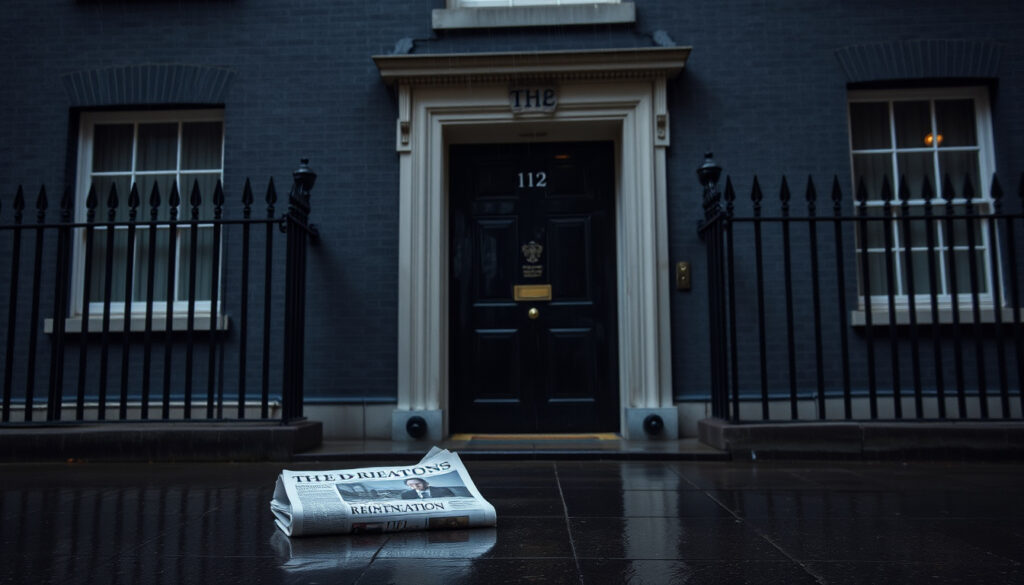
Tony Blair: Why He Resigned, Unpopularity & Downfall
Few moments in modern British politics feel as immediate as Tony Blair stepping outside Trimdon Parish Church on a late-summer morning in 1997 to call a fallen princess ‘the People’s Princess.’ Yet the same man who won three consecutive general elections left office a decade later deeply unpopular, his reputation scarred by the Iraq War and questions of trust, an arc this article traces from that bright August moment to the resignation announcement on 10 May 2007.
Years as Prime Minister: 1997–2007 · General Election Victories: 3 (1997, 2001, 2005) · Age at Appointment: 43 · Number of Terms: 3
Quick snapshot
- Blair resigned as UK Prime Minister on 27 June 2007 (UK government archives)
- He was the youngest Prime Minister of the 20th century (Museum of the Prime Minister (history museum))
- He coined the phrase “the People’s Princess” after Diana’s death (BBC News (British public broadcaster))
- Whether Blair misled Parliament over Iraqi WMD intelligence
- Exact current net worth
- Long-term historical assessment of his legacy
- The precise timing of his agreement to step down for Gordon Brown
- The full extent of Blair’s involvement in the WMD dossier
- 20 March 2003: UK joins Iraq War (Vaia (academic learning platform))
- 10 May 2007: Blair announces resignation; stepped down 27 June 2007 (UK government archives)
- Blair remains active through the Tony Blair Institute for Global Change, advising on governance and Middle East policy
Six facts about the man at the centre of the story.
| Attribute | Detail |
|---|---|
| Full Name | Sir Anthony Charles Lynton Blair |
| Born | 6 May 1953, Edinburgh |
| Political Party | Labour |
| Prime Minister Terms | 1997–2007 |
| General Election Wins | 3 (1997, 2001, 2005) |
| Spouse | Cherie Blair |
Why did Tony Blair resign as prime minister?
Immediate trigger: Labour Party funding scandal
The cash-for-peerages investigation cast a shadow over the final year of Blair’s leadership. While no charges were brought, the affair eroded his authority within the party. But the deeper force was the Iraq War, which had drained public trust.
Iraq War and loss of public trust
By early summer 2004, one poll found 64% of voters did not believe the Prime Minister, as reported by The Atlantic (political magazine). The UK government’s official history acknowledges that the Iraq decision, together with criticism over the use of government machinery and doubts over legality, turned Blair from a previously popular leader into a divisive figure (UK government archives).
Pressure from Labour MPs
Blair faced a large Labour rebellion in 2006 over Israel-Lebanon policy and support for the U.S. administration (UK government archives). PBS News reports that criticism of Blair’s Iraq policy grew more intense inside the party (PBS News (public broadcaster)).
Announcement and transition to Gordon Brown
Blair announced his resignation on 10 May 2007 and formally stepped down on 27 June 2007 (UK government archives). He was succeeded by Gordon Brown, who had served as Chancellor of the Exchequer and had long been seen as Blair’s natural successor. PBS News notes that Blair had effectively “stepped aside in spring 2005 for Gordon Brown” — a reference to a private agreement that later became public (PBS News).
The same leader who won three successive majorities became the most divisive Labour figure of the modern era — because the war he chose destroyed the trust his charisma had built.
The pattern: Iraq destroyed the trust that had carried Blair to office.
What did Tony Blair call Princess Diana?
Context of Diana’s death
Diana, Princess of Wales, died in a car crash in Paris on 31 August 1997. The public grief was unprecedented. Blair, who had been Prime Minister for only four months, was among the first senior politicians to respond publicly.
The phrase ‘People’s Princess’
Speaking outside Trimdon Parish Church in his Sedgefield constituency, Blair said: “She was the People’s Princess and she will remain in our hearts and memories forever” (BBC News (British public broadcaster)). The BBC’s archive shows he added: “They liked her, they loved her, they regarded her as one of the people” — a sentiment that resonated with a nation in mourning.
Impact on Blair’s popularity
At the time, the phrase cemented Blair’s image as a leader attuned to public emotion. The University of Sheffield (academic history site) notes that Blair recognised Diana’s life “was often sadly touched by tragedy,” framing his response as both genuine and politically astute. The moment boosted his early approval ratings significantly.
Why was Tony Blair called Bambi?
Appearance and youthful image
When Blair became Labour leader in 1994 at age 41, his youthful looks — wide eyes, a slim build — drew comparisons to Disney’s deer character Bambi. The nickname stuck through the 1997 election campaign.
Comparison to Bambi
Journalists and political opponents used it to suggest naivety and inexperience. Blair was 43 when elected — the youngest Prime Minister of the 20th century, according to Museum of the Prime Minister (history museum) — so the label carried a double edge: fresh and energetic, but potentially untested.
Use by political opponents
Conservative MPs and tabloids deployed “Bambi” to question whether Blair had the gravitas for the job. Yet his landslide 1997 victory soon silenced the nickname: after winning 418 seats, the “Bambi” image gave way to “Teflon Tony,” reflecting a leader who seemed untouchable.
Why was Tony Blair unpopular?
Iraq War
The decision to join the 2003 invasion of Iraq is widely regarded as the primary driver of Blair’s unpopularity. The weapons of mass destruction that the government had cited as justification were not found (UK government archives). The Atlantic (political magazine) described Iraq as “the chief cause of Blair’s failure,” noting that he led the country into war against public opposition.
Allegations of dishonesty
The failure to find WMDs led to accusations that Blair had knowingly exaggerated intelligence. By 2004, only 36% of voters trusted him to tell the truth — a collapse that his The Atlantic analysis ties directly to Iraq.
Cash-for-peerages scandal
The cash-for-peerages investigation further undermined Blair’s credibility, though no charges were ever brought. It became a symbol of the perception that Blair’s government had become morally compromised.
Divisions within the Labour Party
Labour support for the invasion was deeply controversial inside the party (Museum of the Prime Minister). The 2006 rebellion over foreign policy showed that backbench patience had run out.
What was the downfall of Tony Blair?
Iraq War as turning point
The 20 March 2003 invasion (Vaia (academic learning platform)) marks the moment Blair’s political trajectory shifted from dominance to damage control. As The Atlantic put it, Blair “committed the nation to war not only against the opinion of the majority of his own party but against the view of the country as a whole.”
Erosion of trust
A 2004 poll reported by The Atlantic found 64% of voters did not believe the Prime Minister. That loss of credibility was irreversible in the minds of many voters and MPs.
Labour rebellions
The government’s official history records a large Labour rebellion in 2006 over Israel-Lebanon and continued support for the U.S. (UK government archives). This made it clear that Blair could no longer command his party’s loyalty.
Legacy assessments
Blair remains a deeply divisive figure. The official historians at UK government archives summarise that “the decision over Iraq turned him from a previously popular leader into a divisive figure, a judgment that still affects his legacy.”
What were Tony Blair’s major achievements?
Labour’s longest-serving Prime Minister
Despite his unpopular exit, Blair served as Labour’s longest-serving Prime Minister (UK government archives). He led the party to three consecutive general election victories — a feat unmatched in Labour history (Museum of the Prime Minister (history museum)).
Youngest PM of the 20th century
At 43, he was the youngest person to hold the office since Lord Liverpool in 1812 (Museum of the Prime Minister (history museum)).
Landslide victories
The 1997 election gave Labour a 179-seat majority. Blair repeated the feat in 2001 with a 167-seat majority, and won a third term in 2005, though Labour lost nearly 50 seats compared with its earlier position (Museum of the Prime Minister (history museum)).
The catch: the same electoral dominance that defined his early years became a liability as his legacy narrowed to a single war.
Timeline
- 6 May 1953: Born in Edinburgh, Scotland (Museum of the Prime Minister (history museum))
- 1994: Elected Leader of the Labour Party (Museum of the Prime Minister (history museum))
- 1 May 1997: Won general election, became Prime Minister (Museum of the Prime Minister (history museum))
- 1998: Good Friday Agreement signed (Museum of the Prime Minister (history museum))
- 2001: Re-elected with second landslide (Museum of the Prime Minister (history museum))
- 20 March 2003: Led UK into Iraq War (Vaia (academic learning platform))
- 2005: Won third consecutive general election (Museum of the Prime Minister (history museum))
- 10 May 2007: Announced resignation (UK government archives)
- 27 June 2007: Stepped down as Prime Minister, succeeded by Gordon Brown (UK government archives)
- 2010: Published memoir ‘A Journey’ (Museum of the Prime Minister (history museum))
Clarity section: Confirmed vs. unclear
Confirmed facts
- Blair resigned in 2007 (UK government archives)
- He called Diana “People’s Princess” (BBC News (British public broadcaster))
- He was PM from 1997 to 2007 (UK government archives)
- He led UK into Iraq War (UK government archives)
- He won three general elections (Museum of the Prime Minister (history museum))
What’s unclear
- Whether he misled Parliament over Iraq WMD intelligence
- Exact current net worth
- Long-term assessment of his legacy
- The precise timing of his agreement to step down for Gordon Brown
- The full extent of Blair’s involvement in the WMD dossier
Quotes from key figures
“She was the People’s Princess and she will remain in our hearts and memories forever.”
— Tony Blair, 31 August 1997
“The decision over Iraq turned him from a previously popular leader into a divisive figure.”
— UK Government official history summary
“Blair committed the nation to war not only against the opinion of the majority of his own party but against the view of the country as a whole.”
— The Atlantic, 2004
For a figure who dominated British politics for a decade, the final judgment is still unwritten. The pattern is clear: early brilliance, middle tragedy. What the verdict will be depends on whether the country values his domestic reforms more than it resents the war that consumed his second half in office. For historians, the choice is between a leader who modernised Labour and one who misused its mandate. For voters today, that trade-off remains unsettled.
For more on related figures, see our articles on Anne Princess Royal and John Pesutto.
en.wikipedia.org, en.wikipedia.org, abcnews.com, newhistories.sites.sheffield.ac.uk, reddit.com, youtube.com
For a more detailed timeline of his premiership, see detailed timeline of his premiership.
Frequently asked questions
What is Tony Blair’s religion?
Blair converted to Catholicism in 2007, after leaving office. He had previously identified as an Anglican.
Did Tony Blair have children?
He has four children with his wife Cherie Blair: Euan, Nicky, Kathryn, and Leo.
What is Tony Blair’s education?
He studied law at St John’s College, Oxford, where he earned a second-class degree. He later trained as a barrister.
What is the Tony Blair Institute for Global Change?
Founded in 2016, it is a non-profit organisation that advises governments on strategy, policy, and delivery, with a focus on Africa and the Middle East.
How did Blair become involved in Middle East peace negotiations?
In 2007, he was appointed as the Quartet’s Representative for the Middle East, a role he held until 2015, focusing on Palestinian economic development.
Was Tony Blair knighted?
Yes, he was appointed Knight Companion of the Order of the Garter in 2022 by Queen Elizabeth II, a ceremonial honour.
What is his current role?
He leads the Tony Blair Institute for Global Change, consults on governance projects, and publishes occasional commentary on geopolitics.
More related posts
 The Body Keeps the Score – Trauma’s Effects on Body and Brain
 Margaret Atwood: Biography, Books, Quotes, and Legacy
 Acqua di Gio Absolu: Discontinued? Review, Longevity & Notes
 Nicola Coughlan: Age, Height, Partner, Weight Loss and More
 Kim Young-Kwang: Biography, Age, Height, Dramas, Life
 James Marsden: Biography, Movies, Personal Life, and Net Worth
 Steven Miller: 2025 White House Role & Controversies
 How Old Is Madonna? Age, Key Facts & Net Worth (2025)
