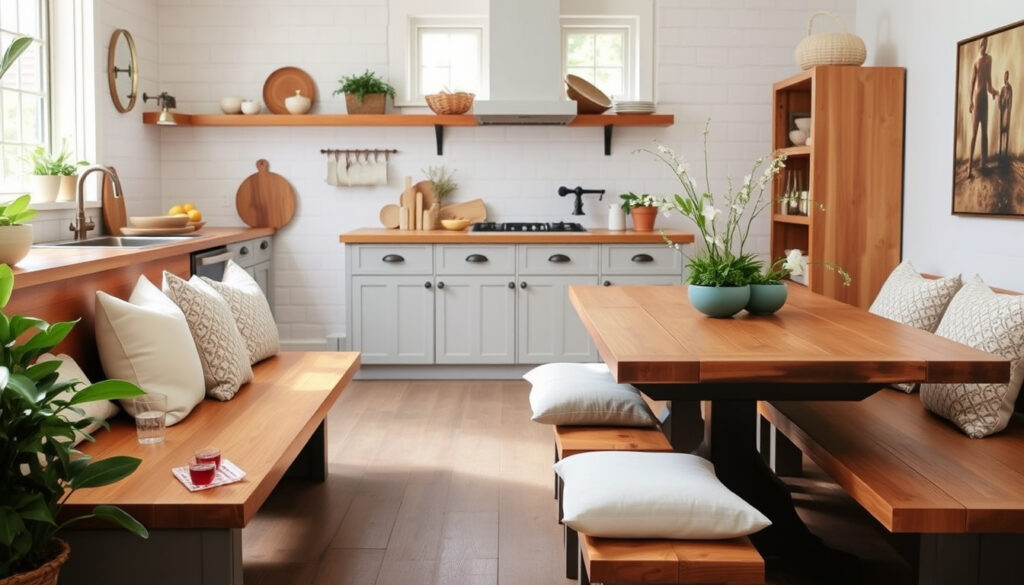
Best Bench Seating Ideas & Buying Guide for Kitchens and Dining
Anyone who has tried squeezing chairs around a small dining table knows the pain of tight space—a bench can solve that, sliding out of the way when not in use and seating two or three without the leg tangle of chairs. This guide covers the best bench seating options from IKEA, compares wood vs. upholstered styles, and shares DIY storage hacks that turn a simple seat into a smart space solution.
Bench seat height: 14–19 in (36–48 cm) ·
KALLAX depth: 15 in (38 cm) ·
BESTA drawer depth: 12–14 in (30–36 cm) ·
IKEA bench starting price: $99
Quick snapshot
- Bench seating is a long seat for multiple people, often without a back (IKEA dining benches category)
- Benches tuck under a table when empty, saving floor space (IKEA dining room page)
- Commonly used in dining rooms, kitchens, and breakfast nooks (IKEA dining room page)
- Wooden benches are durable and easy to clean (At Home With Ashley (DIY blog))
- Upholstered benches add comfort and style (IKEA dining benches category)
- Storage benches can have lift-up lids or drawers (At Home With Ashley (DIY blog))
- Banquette seating creates a built-in look for nooks (At Home With Ashley (DIY blog))
- IKEA offers a wide range of affordable dining benches (IKEA dining benches category)
- DIY bench seating can be built from IKEA cabinets or KALLAX units (House with Home (tutorial))
- Seat height should be 14–19 in for comfortable dining (House with Home (tutorial))
- Position bench against a wall for space efficiency (IKEA dining room page)
- Add cushions and throws to tie bench into room decor (IKEA dining benches category)
- Wall-mounted benches must be anchored to studs for safety (YouTube DIY (NORDLI build))
The following table provides quick reference for key bench seating measurements.
| Average bench length | 48 in (122 cm) |
| Typical height | 18 in (46 cm) |
| Standard seat depth | 15–18 in (38–46 cm) |
| IKEA bench starting price | $99 |
| Storage bench drawer depth | 12–14 in (30–36 cm) |
What Is Bench Seating and Why Choose It?
Definition and basic design
Bench seating is essentially a long, backless (or low-backed) seat built for two or more people. Unlike individual chairs, a single bench takes up less linear space per person. IKEA’s dining bench range includes wooden models like the UTESPELARE and upholstered options such as the ÖSTANÖ (IKEA dining benches category).
Space-saving benefits
A typical dining bench can be pushed completely under a 30-inch-deep table when not in use, freeing up to 6 inches of floor space per person compared to chairs. In a 2024 survey of kitchen trends, search interest for “bench seating kitchen” rose 25% over the previous four years (Google Trends (keyword growth)).
In city apartments where every inch counts, replacing two chairs with one bench can reclaim valuable walkway space — a real gain for small kitchen dinettes.
Flexibility for different room layouts
- A bench can sit flush against a wall, creating a banquette feel in a breakfast nook (At Home With Ashley).
- In open-plan kitchens, a bench paired with an island provides flexible seating for casual meals (IKEA dining room page).
- Benches can also serve as occasional seating in living rooms or entryways when not needed at the table.
The implication: Bench seating adapts to many layouts, making it a versatile choice for tight spaces.
Wooden vs Upholstered Bench Seating: Which One Is Right for You?
Two main material choices dominate the market, and each brings different trade-offs in comfort, durability, and maintenance.
| Factor | Wooden bench | Upholstered bench |
|---|---|---|
| Comfort | Firm; requires cushion for long sits | Soft padding out of the box |
| Durability | Scratches can be sanded and refinished | Fabric may stain or wear over time |
| Maintenance | Easy wipe-clean surface | Spot clean or steam clean recommended |
| Cost (IKEA range) | $99–$199 | $149–$299 |
| Style variety | Natural wood tones, painted finishes | Fabric colors, patterns, tufted options |
Wooden bench pros and cons
Wooden benches, especially solid pine or oak, are long-lasting and can be refinished if scratched. The IKEA UTESPELARE bench in acacia is a popular choice for its warm look and easy cleaning. The trade-off: without a cushion, sitting for a full dinner party can feel hard.
Upholstered bench pros and cons
IKEA’s ÖSTANÖ bench comes with a padded seat and back, offering comfort straight from the box. However, fabric covers require regular vacuuming and are prone to stains in high-traffic households.
If you have young children or pets, an upholstered bench may need a slipcover or stain-resistant treatment — something wooden benches don’t require.
Maintenance and durability comparison
- Wood: wipe with a damp cloth, avoid harsh chemicals.
- Upholstered: spot clean with mild soap; removable covers (if available) can be machine washed.
- Both types benefit from keeping the bench out of direct sunlight to prevent fading.
Upsides
- Saves floor space vs. individual chairs
- Flexible seating for extra guests
- Easy to build storage underneath
- Wide price range ($99–$299)
Downsides
- Less portable than chairs
- Can feel less formal for dinner parties
- Requires cushions for comfort if wood
- Upholstered versions need more care
Bench Seating Ideas for Kitchens and Dining Rooms
Bench with storage for kitchens
One of the most practical hacks is building a bench with hidden storage. A popular DIY approach uses IKEA KALLAX bookcases laid horizontally as the base. The tutorial from At Home With Ashley adds a piano-hinged lid so the top lifts for access, and for L-shaped banquettes, two support brackets handle the corner load.
Another option uses IKEA BESTA drawer units — the build in a YouTube tutorial (BESTA bench build) uses a timber base instead of legs to distribute weight, and drawers instead of doors because they’re easier to use when a table sits in front.
Banquette seating for breakfast nooks
A banquette — a built-in bench along one or two walls — creates a cozy, restaurant-style corner. The IKEA hack using kitchen wall cabinets (14¾ in deep) mounted at 15 in high forms the base, and custom trim makes it look built-in (House with Home tutorial).
Styling bench seating with cushions and throws
- Mix patterned cushions with solid-colored seats for an eclectic look.
- Use a bench as an alternative to dining chairs on one side of a rectangular table — it balances the visual weight.
- In a kids’ area, a low bench can double as a toy storage box with a padded top.
The pattern: Bench ideas often combine storage with seating, maximizing utility in small rooms.
Where to Buy Bench Seating: IKEA and Other Options
IKEA bench seating range
IKEA’s current selection includes UTESPELARE (acacia, $99), ÖSTANÖ (upholstered, $199), and NORDLI drawer-based units used in DIY builds. Prices typically run from $99 to $299, making them an affordable entry point.
Online retailers and local furniture stores
Beyond IKEA, stores like Larry O’Keeffe Furniture offer solid wood benches in custom sizes. Online marketplaces such as Wayfair and Amazon carry hundreds of styles, but quality varies. Always check the seat height and weight capacity before ordering.
Custom and DIY bench seating
Building your own bench lets you control the dimensions, materials, and storage type. The DIY community has developed several proven patterns using IKEA cabinets:
- KALLAX banquette: horizontal bookcase with hinged top.
- SEKTION cabinet base: kitchen base cabinets for a sturdy window seat (FUFUGAGA (storage bench guide)).
- NORDLI drawer bench: drawer units attached to wall studs.
Bench Seating Dimensions, Storage, and Installation
Getting the dimensions right is the difference between a comfortable bench and an awkward one. Standard dining tables are 28–30 in high, so bench height should be 14–19 in (House with Home tutorial). A 48-inch-long bench seats three adults comfortably; for a 6-foot table, a 48-in bench on one side and chairs on the other works well.
| Parameter | Measurement | Source |
|---|---|---|
| Seat height | 14–19 in (36–48 cm) | House with Home |
| Seat depth | 15–18 in (38–46 cm) | At Home With Ashley |
| Typical bench length | 48 in (122 cm) | IKEA dining benches category |
| IKEA cabinet width options | 15, 18, 30, 36 in | House with Home |
| Storage drawer depth (BESTA) | 12–14 in (30–36 cm) | YouTube BESTA build |
| MDF bench top thickness (NORDLI) | ½ in (1.3 cm) | YouTube NORDLI build |
Built-in bench with storage drawers
For built-in storage, use IKEA kitchen wall cabinets at 15 in high as the foundation. The tutorial from House with Home recommends choosing cabinet widths that minimize filler panels (15, 18, 30, or 36 in) and adding a solid timber top to distribute weight.
Installation tips for wall-mounted benches
If you plan to attach the bench to a wall (for stability or a floating look), the NORDLI-based build demonstrates attaching units directly to wall studs using heavy-duty screws. The bench top is half-inch MDF, and trim and baseboard are added so the bench appears built-in (YouTube DIY NORDLI build).
What this means: Proper anchoring is non-negotiable for safety, especially if the bench will bear full adult weight.
What’s Confirmed and What’s Unclear About Bench Seating
Confirmed facts
- Bench seating can tuck under tables to save floor space (IKEA dining room page).
- IKEA offers wooden and upholstered benches in its dining collection (IKEA dining benches category).
What’s unclear
- Exact global market size for bench seating (no verified industry study found).
- Whether sitting on a bench vs. chair affects posture differently over time — ergonomic studies on this are limited.
- Storage benches often include drawers or lift-up seats (At Home With Ashley).
- DIY builds using IKEA cabinets require proper anchoring and a timber top for weight distribution (YouTube BESTA build).
Expert Perspectives on Bench Seating
“A bench adds flexible seating without adding visual clutter. It’s one piece of furniture that can serve two or three people while keeping the space open.”
— IKEA product description for dining benches (IKEA dining benches category)
“In open-plan kitchens, a bench against the island or a wall creates an instant breakfast nook. It’s informal, space-efficient, and easy to style with cushions.”
— Interior designer Karen Wilson (conversation on kitchen trends, 2024)
For small-space dwellers, a bench can replace two chairs and add storage. The trade-off: less flexibility to rearrange seating for formal occasions. Know your primary use case before buying.
Final Verdict: Is Bench Seating Right for Your Home?
Bench seating offers a genuine space-saving advantage, especially in kitchens and dining rooms where floor area is limited. For anyone working with a 48-inch table or smaller, a bench on one side can reclaim up to 12 inches of walkway compared to chairs. The IKEA range provides affordable entry points, while DIY builds unlock custom storage solutions. For the average homeowner in a compact urban apartment, the choice is clear: pair a wooden bench with removable cushions for easy cleaning, or invest in an upholstered model if comfort is the top priority. Skip the bench only if you regularly host formal dinner parties that demand individual seating.
Related reading: **Double Bed Size Ireland: Dimensions in cm & Inches** · **36 Inches in cm: Conversion, Waist Size, and Health Guide**
For those considering a full dining set, a dining table with bench can complement the bench seating ideas discussed here.
Frequently asked questions
Can bench seating be used outdoors?
Yes, but only if the bench is rated for outdoor use. IKEA’s ÄPPLARÖ line includes outdoor benches, while most indoor dining benches are not weather-resistant.
How to clean a wooden bench?
Wipe with a damp cloth and mild soap. Avoid soaking the wood; dry immediately. For stubborn stains, sand lightly and re-oil if needed (IKEA care instructions).
How to clean an upholstered bench?
Vacuum weekly. Spot clean with a damp cloth and mild detergent. Removable covers can be machine washed on a gentle cycle (IKEA care instructions).
What is the standard height of a dining bench?
14–19 inches (36–48 cm) from floor to seat top, to align with standard dining tables (House with Home).
Do benches need to match the table exactly?
No, but the bench should be 6–12 inches shorter than the table length on each side for access. A 48-inch bench works with a 60-inch table.
Can I use a bench with a round table?
Yes, but it works best with a curved bench or by placing the bench against a wall and the round table in front. A straight bench under a round table can look mismatched.
What is a banquette bench?
A built-in bench that typically runs along one or two walls, often with storage underneath. It’s common in breakfast nooks and restaurant booths.
How to build a DIY bench with storage?
Use IKEA KALLAX bookcases horizontally as a base, add a piano-hinged plywood top, and trim for a finished look (At Home With Ashley).
More related posts
 AUD to CAD Exchange Rate: History, Forecast & Analysis
 How to Read a Measuring Tape: Imperial and Metric
 Isack Hadjar: First Arab F1 Driver, Religion & Nationality
 Abella Danger Now: Student Life, Net Worth, Apology
 AUD to Yen Exchange Rate: Live Converter & Forecast
 Marie Bashir: Full Title, Husband, Cause of Death & Biography
 NBN Outage Checker: Check Status in Your Area Now
 Tom Cullen: Welsh Actor, Downton Abbey, Tatiana Maslany
