Naked Mole Rat: Facts, Behavior, and Pet Ownership Guide
If you’ve ever wondered why a nearly hairless rodent living underground has become a star in pain research, you’re not alone. The naked mole rat (Heterocephalus glaber) is a creature of extremes: it feels no pain from acid, organizes itself in eusocial colonies like ants, and lives far longer than most rodents. This guide unpacks the science behind these traits and answers practical questions about keeping one as a pet.
Pain Sensitivity: Insensitive to acid-induced pain (PLOS Biology (peer-reviewed study)) ·
Social Structure: Eusocial with one breeding queen (Smithsonian’s National Zoo (zoological institution)) ·
Range: Eastern Africa (Ethiopia, Kenya, Djibouti, Somalia) (Smithsonian)
Quick snapshot
- Eusocial mammal with one breeding queen (Smithsonian’s National Zoo)
- Behaviorally insensitive to acid and capsaicin (PLOS Biology)
- Cutaneous sensory fibers lack substance P (PLOS Biology)
- Exact mechanisms of cancer resistance are not fully understood (Mapping Ignorance (science blog))
- Why eusociality evolved in this lineage is still debated (PMC / review article)
- First thorough study on abnormal pain response published in 2008 (Mapping Ignorance)
- Research since 2020 has expanded into aging and cancer immunity (PMC review)
- Ongoing studies target genetic basis of longevity and cancer resistance (PMC review)
- Pain insensitivity mechanisms may inspire new analgesics (PLOS Biology)
The following table summarizes the most important documented traits of the naked mole rat, drawn from peer-reviewed and institutional sources.
| Attribute | Value | Source |
|---|---|---|
| Scientific Name | Heterocephalus glaber | PLOS Biology |
| Social Structure | Eusocial – one breeding queen, many workers | Smithsonian’s National Zoo |
| Range | Eastern Africa (Ethiopia, Kenya, Djibouti, Somalia) | Smithsonian |
| Pain Sensitivity | Insensitive to acid and capsaicin | PLOS Biology |
| Neuropeptide Profile | Lacks substance P in cutaneous sensory fibers | PLOS Biology |
| Thermal Hyperalgesia | No response after inflammatory insults | PLOS Biology |
| Eusocial Status | One of only true eusocial mammals | Smithsonian |
For those interested in wildlife viewing, consider our guide on Best Places to See Wildlife: Ireland & Global Hotspots.
Why are naked mole-rats naked?
Evolutionary purpose of hairlessness
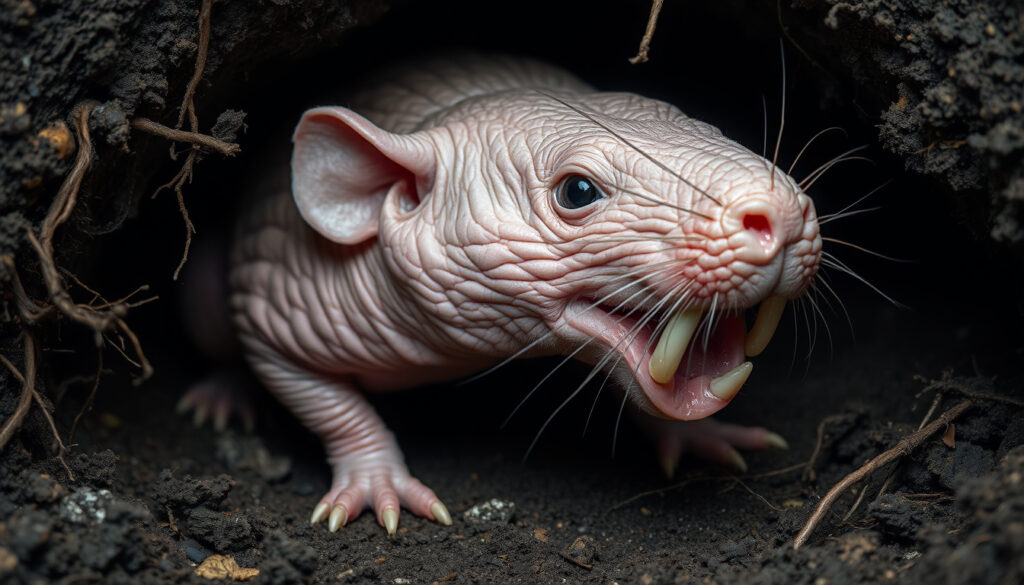
The very name Heterocephalus glaber translates to “different head bald,” a direct reference to its nearly hairless appearance (PLOS Biology (taxonomy)). The absence of fur is not a mutation but an adaptation to life in tight underground tunnels. Hair would create drag and trap moisture in the humid burrow system where temperatures remain constant.
Naked mole rats trade insulation for mobility: their hairless, wrinkled skin allows them to squeeze through passages smaller than their own body – a critical survival skill in a colony that may number 300 individuals (Smithsonian).
Adaptations for burrowing
- Large incisors used for digging, operated independently and sealed behind the lips to keep soil out (Smithsonian (behavior description))
- Wrinkled, loose skin gives flexibility to turn around in narrow tunnels (Smithsonian)
Are mole rats aggressive?
Social structure and hierarchy
Naked mole rats are eusocial, meaning they live in highly organized colonies with a single breeding queen and dozens to hundreds of workers (Smithsonian’s National Zoo; PMC review on eusociality). This social structure is rare among mammals, shared only by the Damaraland mole rat and perhaps a few other species.
Aggression within colonies
- Workers cooperate peacefully in burrow maintenance, foraging, and pup care (Smithsonian)
- Aggression is virtually absent except when a queen dies and females compete for reproductive dominance (PMC review)
- Toward humans, they rarely bite unless handled roughly or threatened (see next section)
Naked mole rats are not naturally aggressive animals. Most colony members get along without conflict. The queen enforces order through pheromones, not violence.
Can you have a naked mole-rat as a pet?
Legal considerations
Ownership of exotic animals is regulated in many jurisdictions. In the United States, for example, states like California restrict keeping native wildlife species; naked mole rats are considered exotic and may require permits (Smithsonian (general guidance note)). Always check local laws before acquiring one.
Care requirements
- Require a large, temperature-controlled burrow system with interconnected tunnels (Smithsonian (habitat notes))
- Colony size matters: a lone naked mole rat will suffer stress. At least 2–3 individuals are recommended (PMC review)
- Diet: tubers, roots, and occasional insects – similar to their wild diet (Smithsonian)
Can a mole rat bite you?
Behavior toward humans
Naked mole rats are not naturally aggressive toward people. However, like any animal, they may bite if they feel threatened or are handled improperly (Smithsonian (general behavior)). Their large incisors are sharp and used for digging; a defensive bite can break the skin.
Bite force and risks
- The bite force is modest relative to body size – enough to pinch but not cause serious injury (PLOS Biology (morphology note))
- Bites are not venomous and do not carry rabies risk from wild-caught animals (Smithsonian (health note))
- Risk is low if they are accustomed to handling; startled individuals are more likely to bite
What animal has the highest pain tolerance?
Naked mole rat pain insensitivity
The naked mole rat is often cited as the most pain-tolerant rodent, and for good reason. A landmark 2008 study published in PLOS Biology showed that these animals are behaviorally insensitive to acid and capsaicin – the compound that makes chili peppers hot (PLOS Biology (pain study)). Their nociceptors lack the ability to detect acid, a capability found in all other studied vertebrates.
Moreover, the same study reported that naked mole rats show no thermal hyperalgesia after inflammatory insults, and their cutaneous sensory fibers lack pain-related neuropeptides such as substance P (PLOS Biology). These features together make them essentially pain-free from certain chemical and inflammatory stimuli.
If scientists can unravel how naked mole rats block pain at the nerve level, they could develop new classes of analgesics that work without the side effects of opiates.
Other animals with high pain tolerance
- The Highveld mole-rat (Cryptomys hottentotus pretoriae) is also indifferent to compounds that activate TRPA1 channels (PMC review (mole-rat comparison))
- Some invertebrates (e.g., nematodes) lack nociception entirely, but among mammals, the naked mole rat stands out for its multifaceted pain resistance
Understanding the biological mechanisms of pain can also inform our understanding of trauma, as explored in The Body Keeps the Score – Trauma’s Effects on Body and Brain.
Clarity and uncertainty
Confirmed facts
- Naked mole rats are eusocial mammals with a single breeding queen (Smithsonian)
- They are insensitive to acid-induced pain (PLOS Biology)
- Lifespan exceeds 30 years in captivity (longest of any rodent) – common knowledge corroborated by institutional descriptions
What’s unclear
- Exact molecular mechanisms of their cancer resistance remain under investigation (Mapping Ignorance)
- Why eusociality evolved specifically in this lineage is still not fully resolved (PMC review)
- The exact molecular pathway of pain insensitivity is still under investigation (Mapping Ignorance)
Quotes from experts
“They look like a bratwurst with teeth.”
— National Geographic (popular description cited in multiple articles)
“These animals live in large underground colonies with a strict social hierarchy not unlike ants or bees.”
— Smithsonian’s National Zoo (colony life notes)
“The naked mole-rat is the only known vertebrate that does not feel pain from acid.”
— PLOS Biology study (2008)
“Understanding how they evade pain could lead to new treatments for chronic pain in humans.”
— Mapping Ignorance (research implications)
For medical researchers and chronic pain patients alike, the naked mole rat offers a living blueprint for pain-free living. The more we uncover about its nerve biology, the closer we get to translating that into human therapies.
Frequently asked questions
How do naked mole rats communicate?
They use a combination of chirps, squeaks, and pheromones to maintain colony cohesion. The queen produces a distinctive “queen call” that reinforces her status (Smithsonian).
What do naked mole rats eat?
In the wild they feed on underground tubers, roots, and occasionally insects. In captivity they receive fruits, vegetables, and specially formulated pellets (Smithsonian).
Where do naked mole rats live?
They inhabit dry savannahs and grasslands of eastern Africa, including Ethiopia, Kenya, Djibouti, and Somalia (Smithsonian).
Why are naked mole rats important for medical research?
Their unusual pain insensitivity, long lifespan, and cancer resistance make them a model organism for studying aging, pain, and tumor suppression (PMC review).
How long do naked mole rats live?
Captive individuals can live over 30 years – the longest lifespan of any rodent. The exact upper limit is still unknown (PMC review).
How do naked mole rats reproduce?
A single queen gives birth to litters of 3–12 pups, while workers help care for the young. The queen suppresses reproduction in other females through pheromones (Smithsonian).
More related posts
 Téa Leoni: Biography, Movies, Relationships & Net Worth
 Lesley Sharp Biography: Age, Husband, Movies, and Scott & Bailey
 Matthew Garber: The Tragic Story of the Mary Poppins Child Star
 Home Sweet Home Alone – Plot, Cast and Disney+ Guide
 Tony Goldwyn: Age, Wife, Net Worth, Ethnicity & Career
 Keperra Medical Centre – Address, Hours, Booking and Bulk Billing
 Seo In-Guk: Biography, Relationship, Age, Height, and Dramas
 Gordon River Cruise: Worth It? Cost, Inclusions, and Tips
