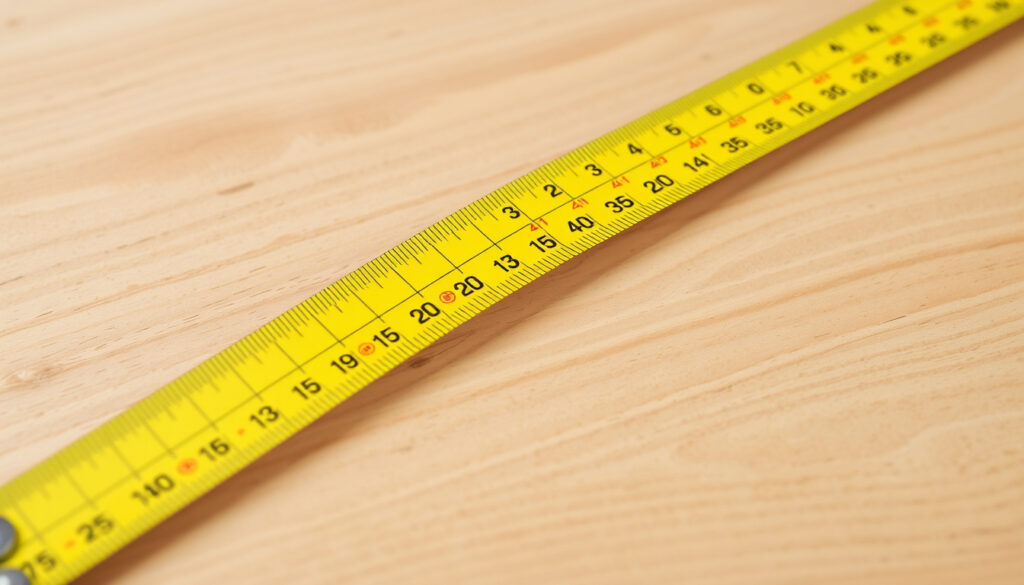
How to Read a Measuring Tape: Imperial and Metric
Anyone who’s picked up a measuring tape and stared at the tiny lines knows the feeling: what do all those marks mean? Unlike a ruler, a tape measure is designed for portability and flexibility, but reading it accurately means juggling imperial fractions and metric decimals.
Standard tape measure length: 25 feet (7.5 meters) for most DIY models ·
Smallest imperial division: 1/16 inch ·
Smallest metric division: 1 millimeter ·
Common blade width: 1 inch (25 mm)
Quick snapshot
- Tape measures are flexible rulers for length measurement (Kreg Tool (woodworking educator))
- Most tape measures have both imperial and metric scales (Bob Vila (home improvement authority))
- Blade length is typically 25 ft (7.5 m) (The Tape Store (measuring specialist))
- Whether a specific phone’s AR accuracy meets professional standards depends on software version (ClarkConnect forum (user community))
- The exact history of the spring-return tape measure is debated (USTape (tape measure manufacturer))
- Physical tape measures remain essential despite the rise of laser and phone-based tools (Bob Vila (home improvement authority))
- Augmented reality measuring apps are improving for rough estimates (Google Play (official app store))
- Apple’s Measure app includes a tape measure tool and bubble level (Apple App Store (official app store))
Six key specs define a standard tape measure, and understanding them helps you choose the right tool and read it correctly.
| Spec | Value |
|---|---|
| Blade length | Typically 25 ft (7.5 m) for general-purpose tapes |
| Blade width | 1 inch (25 mm) for standard tapes |
| Markings | Imperial (inch/fraction) on one side, metric (cm/mm) on the other |
| Hook | Sliding end that moves 1/16 inch for inside/outside measurements |
| Material | Steel blade with protective nylon coating or fiberglass for cloth tapes |
| Accuracy class | Class II (EU) allows ±1.1 mm per 10 m |
Can I use my phone as a tape measure?
Smartphones with augmented reality (AR) can measure distances using the camera and built-in sensors. Apps like the AR Ruler App and Apple’s Measure tool are designed for quick, rough estimates, but their accuracy falls short of a physical tape for precision tasks.
Using built-in AR measuring apps
- Apple’s Measure app provides a tape measure, ruler, height tool, and bubble level (Apple App Store (official listing))
- Android users can install the AR Ruler App to measure rooms and objects (Google Play (official listing))
Third-party ruler apps on Google Play and Apple App Store
- Third-party options like Ruler AR and Moasure offer additional features, but user reviews on forums note variable accuracy (ClarkConnect forum (user community))
Accuracy limitations of phone-based measuring
- AR measurements are typically accurate within 1–2 centimeters at short distances, not suitable for woodworking or construction (Bob Vila (home improvement authority))
- Performance depends on lighting, surface texture, and software version (ClarkConnect forum (user community))
Phone apps work for estimating furniture fit or room dimensions, but a 1-cm error can ruin a cabinet cut. For any project requiring tolerances tighter than 5 mm, reach for a steel tape.
Why this matters: A phone is fine for rough checks, but using it for precision work risks wasted material and rework. The real choice is between convenience and accuracy.
How do I read a measuring tape?
Reading a tape measure means interpreting two entirely different numbering systems: imperial fractions (inches, halves, quarters, eighths, sixteenths) and metric decimals (centimeters and millimeters). Most tapes display imperial on the top edge and metric on the bottom.
Reading imperial markings: inches, halves, quarters, eighths
- The longest numbered marks are whole inches, with slightly shorter marks for 1/2, 1/4, 1/8, and 1/16 inch (Kreg Tool (woodworking educator))
- A 16-foot tape measure has sixteen one-foot marks and 192 one-inch marks (The Tape Store (measuring specialist))
Reading metric markings: centimeters and millimeters
- Large numbered markings are centimeters; the smallest divisions are millimeters, with 10 mm in every cm (The Tape Store (measuring specialist))
- Some metric tapes print the 1-meter mark as 100 centimeters rather than “1m” (USTape (tape measure manufacturer))
Interpreting fractional and decimal notations like 2.25
- A reading of 2.25 inches means 2 and 1/4 inches — the 1/4-inch mark after the 2-inch line (Kreg Tool (woodworking educator))
- When a tape shows decimal inches (2.25), it’s often on the metric side converted to imperial for convenience (The Tape Store (measuring specialist))
Mixing up metric and imperial fractions is the #1 cause of measurement mistakes. Practice reading both systems until you can switch without thinking.
The implication: mastering both systems eliminates a major source of error and speeds up any measuring task.
Does a measuring tape use cm or mm?
Most measuring tapes sold globally include both scales. The metric side uses centimeters (cm) as the large numbers and millimeters (mm) for the small marks. The relationship is simple: 1 cm = 10 mm, 100 cm = 1 m.
Dual-scale tapes with imperial on top and metric on bottom
- In the United States, imperial markings dominate, but many tapes now include metric for international use (Bob Vila (home improvement authority))
- In India, the metric system is official; imperial is often printed for reference only (Freemans Group (measurement product supplier))
Understanding the difference between cm and mm
- The metric system is base-10: 10 mm = 1 cm, 100 cm = 1 m (USTape (tape measure manufacturer))
- Each centimeter mark is the longer line; each millimeter is the shortest line between them (The Tape Store (measuring specialist))
Correct notation: 20 mm (space before unit) per ISO 80000-1
- International standard ISO 80000-1 requires a space between the number and unit, e.g., “20 mm” not “20mm” (USTape (tape measure manufacturer))
The pattern: If you see numbers 1, 2, 3 with no fraction marks, you’re on the metric side. Count the tiny lines between them to get millimeters. This simple rule avoids confusion.
What can I use if I don’t have a measuring tape?
When you’re without a tape, a few everyday substitutes can provide a rough measurement — though none match its precision for serious work.
Using a smartphone measuring app
- Apple’s Measure app and Google’s AR Ruler can estimate length for casual use (Google Play (official app store))
Using a piece of string or paper
- String can be laid along a curve then straightened and measured against a ruler (The Tape Store (measuring specialist))
Using common objects with known dimensions
- A standard credit card is a portable reference (ISO/IEC 7810 ID-1 size) — but for exact numbers, measure it once with a tape (USTape (tape measure manufacturer))
Every alternative trades accuracy for convenience. For a critical cut, borrow a tape measure rather than guess.
What this means: when precision matters, always prefer a physical tape over any substitute.
How to use a measuring tape for beginners?
Using a tape measure correctly isn’t just about reading numbers — it’s about technique. Small mistakes like sagging, parallax error, or forgetting the hook movement can add up to real inaccuracies.
Getting accurate measurements inside and outside
- Hold the tape straight and level; any sag adds length (Kreg Tool (woodworking educator))
- For inside measurements, add the width of the case (usually 3 inches) to the reading (The Tape Store (measuring specialist))
Avoiding common errors: sagging, parallax, hook misalignment
- Parallax error — reading the marking from an angle — can be prevented by reading at eye level (USTape (tape measure manufacturer))
- The hook slides 1/16 inch to compensate for its own thickness when pushing vs. pulling (Kreg Tool (woodworking educator))
Reading fractions and converting between units
- Start with the nearest whole inch, then count the smaller marks to the right to get the fraction (The Tape Store (measuring specialist))
- To convert inches to centimeters, multiply by 2.54; for centimeters to inches, divide by 2.54 (USTape (tape measure manufacturer))
The consequence: consistent practice turns good technique into second nature, eliminating costly errors.
Step-by-Step: How to Measure Accurately
Even experienced DIYers can get tripped up by the hook’s sliding movement or the case-width add. Follow these steps for a perfect measurement every time.
- Choose the correct side – Use imperial or metric based on your project. Most tapes have imperial on top, metric on bottom.
- Hook it right – For outside measurements, hook the end over the edge. For inside, press the end against the starting surface. The hook slides 1/16 inch to adjust (Kreg Tool (woodworking educator)).
- Keep it taut and level – Avoid sagging; hold the tape straight. Use a second person for long distances (Kreg Tool (woodworking educator)).
- Read at eye level – Parallax error skews readings. Squat or bend so your eye is directly over the marking (USTape (tape measure manufacturer)).
- Identify the marks – On imperial, find the nearest inch, then count the smaller marks to get the fraction (1/2, 1/4, 1/8, 1/16). On metric, the large numbers are cm, the small ticks are mm (The Tape Store (measuring specialist)).
- Write it down – Record the measurement immediately; don’t trust memory for fractions or millimeters.
Applying these steps consistently turns measuring into a reliable skill.
What we know and what we don’t
Confirmed facts
- Tape measures are flexible rulers with both imperial and metric scales (Kreg Tool)
- The hook moves 1/16 inch to adjust for its own thickness (Kreg Tool)
- Smartphone AR apps can measure distances but with limited accuracy (Google Play)
What’s still unclear
- The exact history of the spring-return tape measure is debated (USTape)
- Whether a specific phone’s AR accuracy meets professional standards depends on software version (ClarkConnect forum)
For the DIYer or hobbyist, a physical tape remains the most reliable measuring tool — it doesn’t need batteries, calibration, or a software update. The real vulnerability is user error, and that’s exactly what this guide helps you eliminate.
Related reading: How to Read a Measuring Tape: Metric vs Imperial Guide · Measuring Tape App vs Physical Tape: When to Use Each
freemansgroup.com, youtube.com, facebook.com, thetapestore.co.uk, perfectmeasuringtape.com
Frequently asked questions
How do I keep my tape measure from rusting?
Wipe the blade with a dry cloth after use and store it in a dry place. Some tapes have a nylon coating that resists rust (The Tape Store).
What is the difference between a tape measure and a ruler?
A tape measure is flexible and can measure curves and longer distances, while a rigid ruler is better for straight, short measurements and drawing lines (Kreg Tool).
How to measure curved surfaces with a tape measure?
Use a flexible cloth or fiberglass tape that conforms to curves. For a tight curve, mark the tape at intervals and sum the segments (USTape).
What are the parts of a tape measure?
The key parts are the blade (steel or fiberglass strip), the hook (sliding end), the case (housing), and the lock (holds the blade in place) (The Tape Store).
Can a tape measure be used for body measurements?
Yes, a soft cloth or fiberglass tape is ideal for body measurements. Standard steel tapes are not comfortable and may scratch skin (USTape).
How to calibrate a tape measure?
Check the hook against a known standard, like a steel ruler. The hook should slide exactly 1/16 inch. If it sticks, clean the slot (Kreg Tool).
What is the maximum length of a measuring tape?
Consumer tapes typically go up to 100 ft (30 m); specialty surveyor tapes can reach several hundred feet (Bob Vila).
For anyone who regularly takes measurements, the choice between a tape measure and a phone app is clear: use a physical tape for anything requiring better than 5 mm accuracy. The phone is a handy backup, but the tape measure remains the undisputed workhorse of the toolbox.
More related posts
 Martin Compston: Net Worth, Wife, Football Career, and TV Shows
 Joanna Lumley: Biography, Health, and Family Facts
 Manta Ray Facts: Safety, Behavior, and Stingray Differences
 1 AUD to INR: ₹67.34 Rate, Forecast & Converter
 Hardware and General: Newcastle West Supplies & Velux
 Sydney Flower Markets – Location Hours and Visiting Tips
 Allison Langdon: Biography, Salary, Family & What Happened
 Zac Bailey: Biography, Suspension, Free Agency, Salary & Stats
